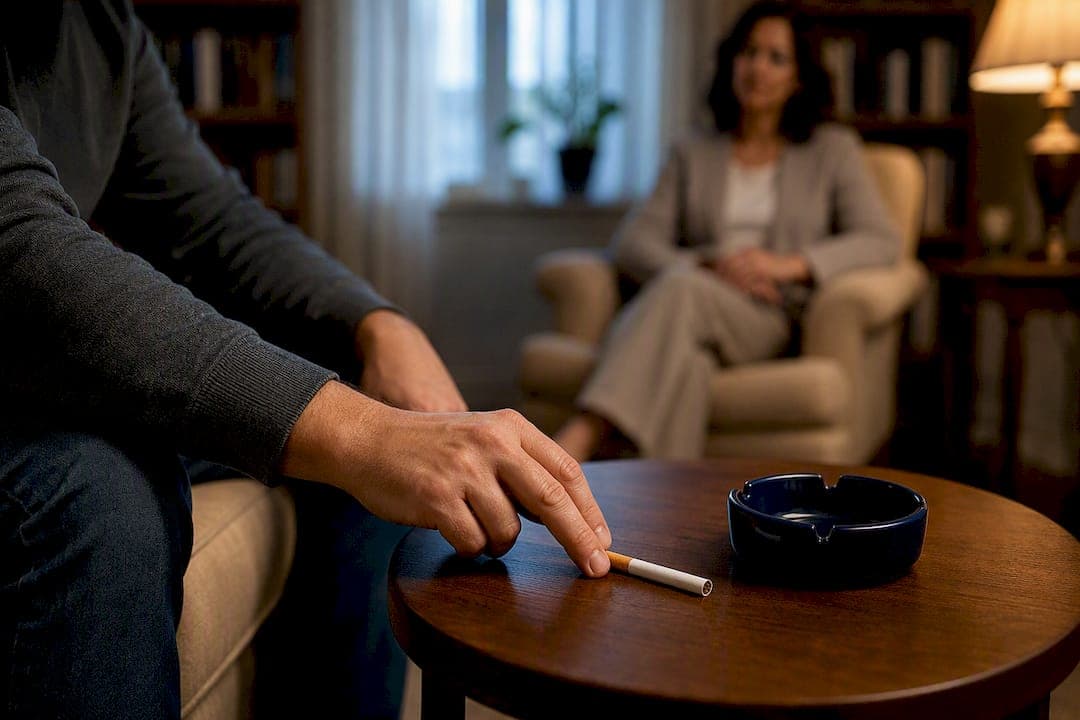
Most people who quit smoking with hypnotherapy do it in one to six sessions. Clinical trials show a clear pattern: the more sessions someone completes, the higher the odds of staying smoke free at 12 months. A randomized controlled trial found abstinence increased notably with more sessions completed, with a clear rise from those attending four sessions to those completing all six. Your exact number depends on how long you've smoked, why you smoke, and how anxious your nervous system is around quitting.
TL;DR:
- Completing all six hypnotherapy sessions more than doubles the chance of remaining smoke-free at 12 months.
- Higher nicotine dependence, longer smoking history, and coexisting anxiety generally require more sessions and boosters for effective quitting.
- Tailoring the treatment format to individual needs and ensuring session adherence significantly improve success rates.
- Shorter, intensive sessions suit motivated light smokers, while longer programs with follow-up boosters benefit heavier, dependence-prone smokers.
- Success hinges more on completing the planned sessions than on the specific protocol, with personalized follow-up boosting long-term abstinence.
Table of Contents
- How many hypnosis sessions to quit smoking, and how are they structured?
- What factors decide how many sessions you actually need?
- What does the research actually say about session count and success?
- What happens inside a session, and how do formats differ?
- What should you budget for time and money?
- How do you choose a hypnotherapist and what should you ask them?
- Clinician perspective: when I recommend one session versus a series
- How Hypnotic Transformations can help you quit for good
- Sources
How many hypnosis sessions to quit smoking, and how are they structured?
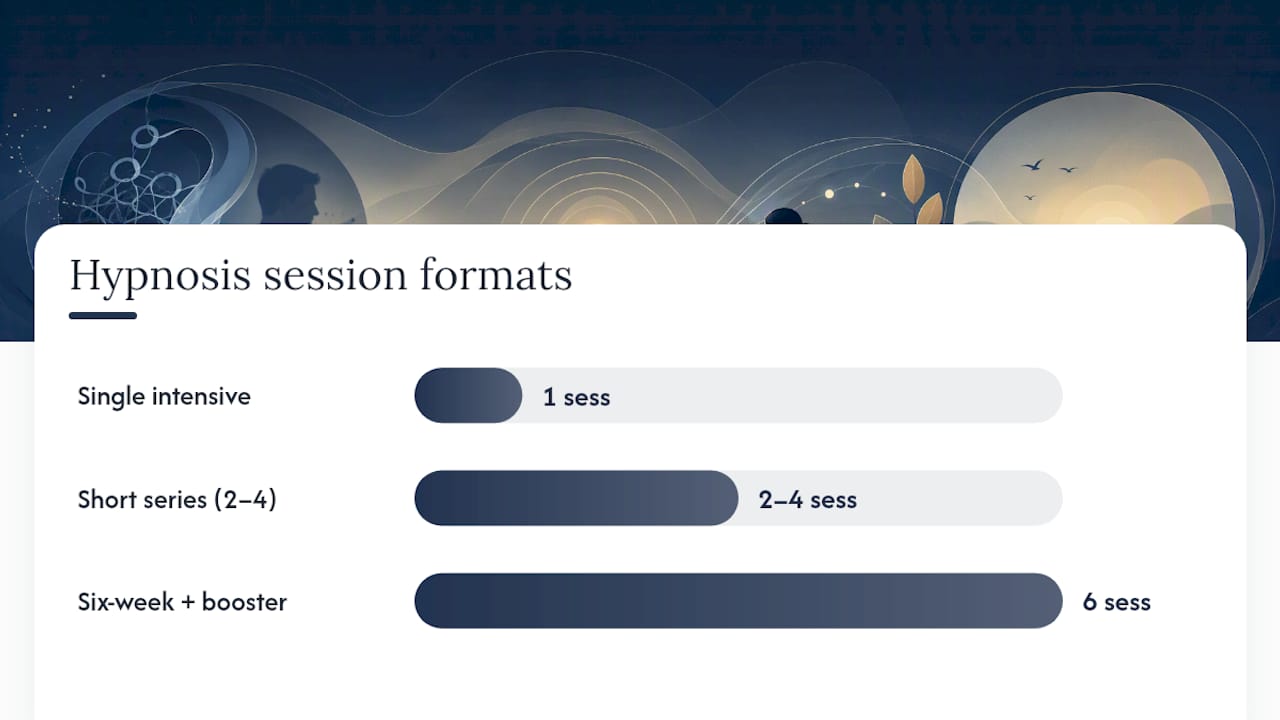
There's no single script for this. Some clinics run a single intensive two-hour session designed to hit the habit hard before it can regroup. Others space out a short series, usually two to four sessions, spread across two to three weeks. A third format, closer to what shows up in clinical research, runs six weekly sessions over six weeks, often paired with booster check-ins afterward.
The research behind these numbers is wide open on format. A systematic review of hypnotherapy trials found protocols ranging from a single session to eight sessions, with total hypnosis time across a program ranging from 30 minutes to nine hours. That spread tells you something important: there's no magic number that works for everyone. What matters more is matching the format to the person.
In private practice, here's what you'll typically encounter:
- Single intensive session: One extended appointment, often 90 minutes to two hours, aimed at light or moderate smokers with strong motivation and no major anxiety component.
- Short series (2 to 4 sessions): The most common private-practice recommendation, giving the client repeated exposure to new associations around smoking triggers.
- Six-week program: Weekly sessions that mirror the structure used in smoking cessation trials, often chosen for people with a longer smoking history or higher dependence.
- Booster arrangements: Follow-up sessions at set intervals after the core program ends, aimed at locking in the change during high-risk windows.
If you smoke half a pack a day and started quitting cold turkey attempts three years ago, a short series probably covers it. If you've smoked two packs a day for twenty years and use cigarettes to manage panic, you're a better candidate for the longer format with boosters built in.
What factors decide how many sessions you actually need?
Session count isn't guesswork. A few concrete variables push people toward the short end or the long end of the range, and knowing where you land helps set realistic expectations before you book anything.
- Nicotine dependence and cigarettes per day. Someone smoking five cigarettes a day has a different nervous system relationship with nicotine than someone smoking two packs. Higher daily intake generally means more sessions to fully retrain the automatic reach for a cigarette.
- Duration of smoking and prior quit attempts. A habit built over two decades has laid down deeper subconscious grooves than one built over two years. Multiple failed quit attempts also suggest the habit is tied to something beyond nicotine, like stress relief or identity, which takes more session time to unwind.
- Emotional smoking and coexisting anxiety. If cigarettes function as a fast, physical way to interrupt a fight-or-flight spike, hypnotherapy has to do double duty: address the smoking behavior and give the nervous system a replacement tool for calming itself down. That usually means more sessions than a purely habitual smoker needs. Our guide to hypnosis for anxiety-driven smokers breaks this down in more detail.
- Motivation and follow-through on home practice. People who listen to their reinforcement audio between sessions and actively engage with relapse-prevention planning tend to need fewer total sessions than people who show up and expect the work to happen passively.
A skilled hypnotherapist adjusts the plan as you go rather than locking you into a fixed number on day one. If session two shows you're responding fast, the plan shortens. If old triggers resurface, it extends.
What does the research actually say about session count and success?
The clearest evidence comes from a 2024 randomized controlled trial comparing hypnotherapy to cognitive behavioral therapy across six weekly group sessions. The finding that matters most: abstinence at 12 months tracked almost linearly with how many sessions someone completed.
Participants who attended four sessions reached 11.8% abstinence at 12 months. Attending five sessions raised that to 17.4%. Completing all six sessions more than doubled it again, to 37.3%.
The takeaway in one line: finishing the full course of sessions more than triples your odds of staying smoke free a year later compared to stopping partway through.
That's not a small effect. It's also not a guarantee, and here's where honesty matters more than marketing. A broader systematic review looking across many hypnotherapy trials found wide variation in protocols, delivery methods, and outcomes. Some single-session studies report strong results. Others using multi-session formats show more modest effects. Older Cochrane analyses have flagged inconsistent findings across studies due to differences in study quality, sample size, and how "success" gets measured.
What ties these threads together isn't the number of sessions by itself. It's adherence. Showing up for the sessions you scheduled predicts abstinence better than any specific protocol length. That's why a hypnotherapist's real job in the first session often isn't just induction work. It's building a schedule you'll actually stick to, because a six-session plan you complete beats an eight-session plan you abandon after three visits. For readers who want the fuller data picture, our breakdown of hypnosis success rate research covers additional outcome studies. Behavioral tools like Smokefree offer free quitline support and text programs that pair well with a structured hypnosis plan, particularly for filling the gaps between sessions.
What happens inside a session, and how do formats differ?
A typical clinical session runs 60 to 90 minutes, though intake sessions often run longer and later sessions can be shorter. Here's roughly what to expect inside that window:
- Intake and history: the practitioner asks about your smoking pattern, triggers, past quit attempts, and any anxiety or stress that ties into the habit.
- Induction: a guided process that shifts you into a relaxed, highly focused state where the subconscious mind is more receptive to new suggestions.
- Suggestion work: direct and metaphorical language aimed at breaking the automatic link between triggers (stress, coffee, driving, a drink) and reaching for a cigarette.
- Relapse-prevention planning: concrete strategies for the first during the 72 hours and first few weeks, when cravings and withdrawal symptoms peak.
- Take-home practice: audio recordings or short exercises meant to reinforce the session's work between appointments.
Group-based clinical trials, like the six-week RCT format, run standardized 90-minute weekly sessions with a fixed group and fixed script. Individual private practice looks different. Sessions get tailored in real time based on what comes up, which is part of why a therapist might shorten or extend a plan mid-course. Audio-only or app-based programs compress the format further, sometimes into 20 to 30 minute daily listens over a week or two, though these generally don't match the personalization of one-on-one work.
Pro Tip: Ask your hypnotherapist whether take-home audio is included in your package. Reinforcement between sessions is one of the biggest predictors of whether the new association actually sticks by week three.

What should you budget for time and money?
Private-practice pricing for smoking cessation hypnosis varies by region and practitioner experience, but a few patterns hold across most programs.
- Single intensive session: typically the highest single-appointment price point, since it packs 90 to 120 minutes of concentrated work into one visit.
- Short series (2 to 4 sessions): usually sold as a package with a lower per-session cost than paying for single visits individually.
- Six-session or six-week program: the highest total investment, but it's also the format tied to the strongest research outcomes described above.
- Booster sessions: typically priced lower than core sessions and scheduled at one, three, and six months after the main program ends.
Skipping boosters to save money is where a lot of otherwise-successful quits fall apart. Relapse risk peaks in the first few months, and a single check-in session during that window costs far less than restarting a full program later. Our breakdown of smoking hypnosis pricing covers specific price ranges in more detail.
If budget is tight, pair hypnosis with free resources rather than skipping structure entirely. A structured 12-week quit plan or the free tools at Smokefree.gov can fill gaps between paid sessions without costing anything extra.
How do you choose a hypnotherapist and what should you ask them?
Not every practitioner offering "quit smoking hypnosis" has the same training or approach, and the difference shows up in your results.
- Check for real clinical credentials. Look for a Certified Clinical Hypnotherapist (CCHt) designation and evidence of supervised clinical training, not just a weekend certificate.
- Ask what session count they recommend for your situation, and why. A practitioner who gives you the same fixed number regardless of your smoking history hasn't actually assessed you.
- Ask whether boosters are included or offered separately. A program with no relapse-prevention follow-up plan is missing a piece the research consistently supports.
- Ask how they measure success. Vague answers like "most people feel great" are a red flag. A solid answer references abstinence tracking, follow-up check-ins, or a defined relapse policy.
- Ask what happens if you relapse mid-program. A practitioner with a clear, calm answer (adjusted sessions, added boosters, revised timeline) is more trustworthy than one who treats relapse as failure.
If cigarettes double as your anxiety management tool, ask specifically whether the practitioner addresses that link, or whether they treat smoking cessation in isolation. That distinction changes which sessions you need and how many.
Clinician perspective: when I recommend one session versus a series
People ask me for a number before they ask me anything else, and I understand why. But the honest answer is that the number follows the assessment, not the other way around.
Here's the pattern I actually use. A light smoker with a short history, no major anxiety component, and high motivation often does fine with a single intensive session or a short series of two to three. Someone whose smoking is tangled up with panic, chronic stress, or a fight-or-flight response that fires all day gets a different plan. That person needs more time in early sessions just mapping triggers before we ever set a quit date, and boosters at one, three, and six months aren't optional extras for them. They're part of the design.
The clinical trial data backs this instinct. Completion matters more than any fixed protocol. My job in session one is building a schedule someone will actually finish, because a shorter plan completed beats a longer plan abandoned.
— Kirk
How Hypnotic Transformations can help you quit for good
If you've read this far, you already know the number that matters most isn't one to six. It's the number of sessions you actually complete. Hypnotic Transformations builds that completion into the plan from the first conversation, with online sessions led directly by Certified Clinical Hypnotherapist Kirk Hoffman rather than a recorded script or a rotating staff.

Sessions run as a single intensive appointment, a short series, or a structured multi-week program with booster check-ins at one, three, and six months, depending on your smoking history and whether anxiety plays a role in your cravings. That last part matters more than most quit-smoking programs acknowledge. When cigarettes are doing double duty as a stress reliever, treating the habit alone leaves the underlying trigger untouched. Kirk works directly with that connection between the subconscious mind and the nervous system's fight-or-flight response, rather than treating smoking as an isolated behavior.
Book a free consultation through the quit-smoking hypnotherapy program page to talk through your smoking history and get a session plan built for your specific situation, not a generic number pulled from an average.
Sources
The session and abstinence figures in this article come primarily from a randomized controlled trial comparing hypnotherapy and CBT for smoking cessation and a systematic review of hypnotherapy protocols and outcomes. For free, practical quit support to pair with any hypnotherapy program, Smokefree.gov offers quitline access, text-based coaching, and planning tools at no cost. Readers managing a heavier smoking history may also find the structured 12-week quit plan from BreatheFree useful as a companion resource.
This article is general information, not a substitute for advice from a qualified doctor. Consult a qualified healthcare professional about your own circumstances before acting on anything here.
- Hypnotherapy compared to cognitive-behavioral therapy for smoking cessation in a randomized controlled trial - PMC
- Smokefree