
Guided visualization for manifestation is a mental rehearsal practice where you imagine a desired outcome in vivid, first-person detail while your body physically registers the feeling of already having it. Start now: sit up, feel your feet on the floor, take four slow breaths, and picture one goal as if it just happened. The full script, the neuroscience behind it, and how to build a daily practice follow below.
TL;DR:
- Guided visualization works best when it includes grounding, intention setting, scene immersion, feeling anchoring, and gradual re-entry; skipping any step reduces its effectiveness.
- The practice activates sensory and motor brain regions similar to actual experience, strengthening the neural pathways associated with the desired outcome.
- Consistent daily sessions of 10 to 12 minutes, especially morning or pre-sleep, are recommended for at least 21 days to observe subconscious shifts.
- Pairing visualization with methods like scripting or affirmations enhances results, particularly when practiced over a three-week period before switching approaches.
- Clinical hypnotherapy can address deeper subconscious beliefs causing anxiety or blocks that visualization alone cannot resolve.
Table of Contents
- What Is a Guided Visualization Script for Manifestation?
- Why Does Embodied Visualization Actually Work?
- How Should You Prepare and Schedule Your Practice?
- Which Manifestation Method Should You Pair With Visualization?
- What If Visualization Brings Up Anxiety Instead of Calm?
- How Do Clinical Hypnotherapists Use Guided Imagery Differently?
- When Should You Book a Session Instead of Practicing Alone?
- Ready to Work Through What's Blocking You?
- A Practitioner's Honest Take on Solo Visualization
- Sources
What Is a Guided Visualization Script for Manifestation?
A working script does five things in order: ground you, state your intention, drop you into the scene, anchor the feeling in your body, and bring you back out gently. Skip any one of these and the practice loses power. Here's a full 8 to 10 minute version you can follow right now, either read aloud slowly or recorded on your phone.
- Ground (60 seconds). Sit or lie down. Feel where your body touches the chair or floor. Take four breaths, each one slightly longer on the exhale than the inhale.
- State the intention (15 seconds). Say it in the present tense, out loud or silently: "I am confident and calm walking into this interview" rather than "I want to feel confident someday."
- Enter the scene (4 to 5 minutes). Picture yourself inside the moment, not watching from outside. What do you see in front of you? What sounds are nearby? What are you touching, wearing, smelling? Notice the position of your own hands.
- Anchor the feeling (1 to 2 minutes). Locate where the success feeling shows up physically. Warmth in your chest. Shoulders dropping. A slight smile. Place a hand there and hold it for three breaths. This is the cue you'll use later to recall the state in seconds.
- Re-enter gradually (60 seconds). Wiggle your fingers, feel the room again, and name one small action you'll take today that lines up with the scene you just imagined.
This somatic approach, feeling the scene from inside your own skin rather than observing it from a distance, is what InsightTimer's guided somatic visualization for abundance practices are built around, and it's the difference between wishful daydreaming and rehearsal your nervous system actually registers.
Why Does Embodied Visualization Actually Work?
Your brain has a filtering system called the reticular activating system, or RAS, that decides which information gets your attention out of the thousands of signals hitting your senses every second. Rehearsing a goal repeatedly primes the RAS to notice matching opportunities you'd otherwise scroll past.
There's also imaging evidence behind the practice. Clinical research on guided imagery reviewed by Cleveland Clinic shows that vivid mental rehearsal activates overlapping regions in the visual and motor cortex, the same areas that fire during the real physical experience. Your brain doesn't fully distinguish a well-rehearsed image from a lived one.
The somatic piece matters because feeling the sensation, not just picturing the image, is what signals "this is real and safe" to your nervous system. Coaching research from BetterUp backs the first-person, sensory-first approach over watching a scene like a movie. None of this replaces effort. Visualization primes your attention and calms your body. Getting the outcome still requires you to take the aligned action your rehearsal points you toward.
How Should You Prepare and Schedule Your Practice?
Set up matters more than people expect. Sit somewhere quiet, dim the lights if you can, and put your phone on silent, not just vibrate. Headphones help block ambient noise if you're using a recorded track.
- Warm up with a slow breath count, four seconds in, six seconds out, for about a minute before you start.
- Pick your length based on the moment: a 5-minute version for a midday reset, a 10 to 12 minute standard session (a common range for guided manifestation tracks), or a slower 20-minute version before bed.
- Build a simple weekly rhythm: full practice each morning, a 60 second body check at midday, and a short anchor touch before sleep.
- Commit to 21 days minimum before judging results. Guided somatic tracks that recommend this window do so because subconscious pattern change rarely shows up after one or two sessions.
Morning and pre-sleep repetition shows up again and again in top-rated guided abundance practices, likely because those are the two windows when your mind is naturally quieter and more suggestible.
Which Manifestation Method Should You Pair With Visualization?
Visualization works better paired with a second method that matches how you process information. Trying to do all of them at once usually backfires and you end up doing none consistently.
- 369 method (writing your intention 3 times morning, 6 times midday, 9 times night): best for verbal processors who think in words.
- Vision board: best for visual learners who need to see the goal, not just imagine it.
- Scripting (journaling the outcome as if it already happened): good for people who process by writing things out.
- Affirmations spoken aloud: pair naturally with visualization since both use present-tense language.
- Pillow method: writing an intention and placing it under your pillow, aimed at reinforcing the goal right before sleep.
- Mind movie (a short video of images set to music): suits people who respond to fast visual and audio input together.
Verywell Mind's guide to manifestation techniques recommends combining a written method with visual and emotional practice rather than relying on one alone. Start with guided visualization plus scripting or affirmations, since both reinforce the same present-tense language your script already uses. Give that combination 21 days before you swap it for something else.
What If Visualization Brings Up Anxiety Instead of Calm?
Sometimes a visualization session stirs up discomfort instead of ease. An old fear surfaces, or an image feels intrusive rather than peaceful. That reaction is normal. It usually means the exercise touched a belief your nervous system was protecting.
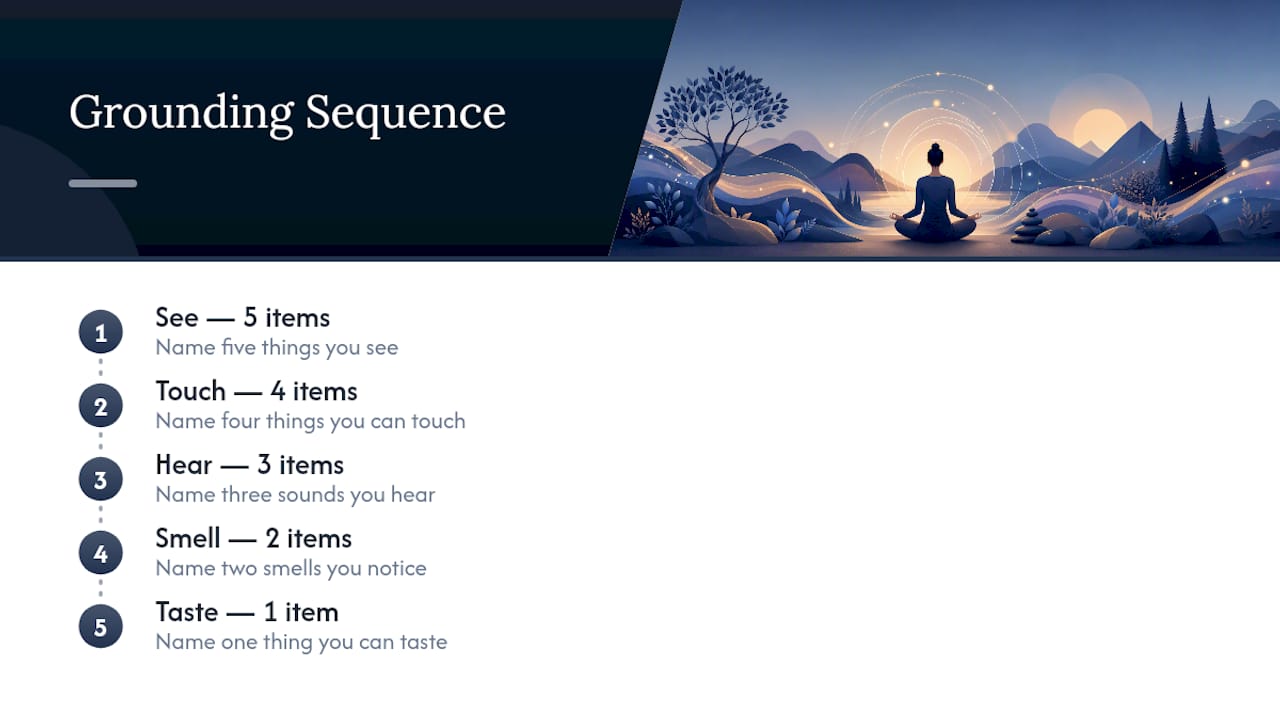
If that happens, stop the scene and ground first. Try 5-4-3-2-1: name five things you see, four you can touch, three you hear, two you smell, one you taste. Or count your breath for one minute using Paul Stebles' grounding protocol. Return to the visualization only once your body feels settled, and use a gentler version of the scene.
If panic, repeated intrusive images, or worsening anxiety continue across sessions, pause solo practice and talk to a clinician. Internal shifts, calmer reactions, quieter self-talk, usually show up before anything changes on the outside. Pair the visualization with one real action toward your goal, not instead of it.
How Do Clinical Hypnotherapists Use Guided Imagery Differently?
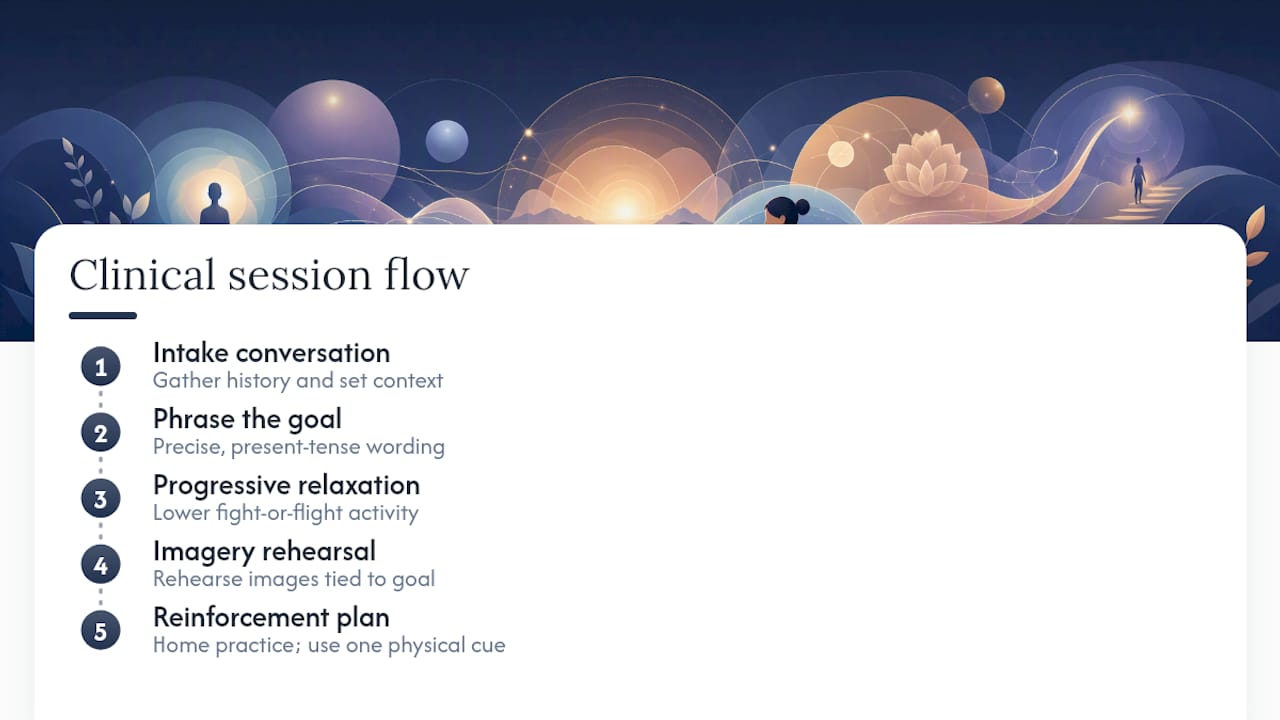
A clinical session goes further than a recorded track because it combines nervous-system regulation with direct work on the belief blocking you. A typical flow: intake conversation, phrasing the goal in precise, present-tense language, progressive relaxation to lower fight-or-flight activity, imagery rehearsal built around that specific goal, then a reinforcement plan for home. [author_bio] [brand_signal] [internal_data]
Pro Tip: Pick one physical cue, a hand on your chest, a specific breath pattern, and use it every single session. Repetition turns it into a fast shortcut back to the calm, focused state later, without needing the full script.
When Should You Book a Session Instead of Practicing Alone?
Most people who come to us describe the same thing: a goal they can picture clearly but can't seem to move toward, blocked by anxiety that shows up as tight chest, racing thoughts, or full avoidance. Solo visualization helps with everyday goals and mild stress. Book clinical hypnotherapy when the same fear keeps resurfacing, when anxiety feels constant rather than situational, or when intrusive images keep interrupting your day. With consistent practice, most clients notice real internal shifts within 2 to 4 weeks.
Ready to Work Through What's Blocking You?
A recorded script can calm your body for a few minutes. It can't identify the specific belief telling your nervous system that success is unsafe, or that fear is protecting you from something. That's the gap clinician-led sessions close.
Kirk Hoffman, a Certified Clinical Hypnotherapist, works with clients online through Hypnotictransformations to address the subconscious patterns behind anxiety, panic, and blocked goals, including manifestation blocks tied to the law of attraction. Sessions combine progressive relaxation with guided imagery built around your exact goal, not a generic script. If anxiety, repeated fear, or a pattern you can't shake on your own is the real obstacle, a first consultation is the place to find out what's underneath it. Book a session or explore anxiety-focused hypnotherapy to see if it fits what you're dealing with.
A Practitioner's Honest Take on Solo Visualization
The fear I see most often isn't "I can't visualize." It's "I visualize it perfectly, then I freeze the second I try to act on it." That gap between the mental rehearsal and the real-world step is where fight-or-flight takes over, and no script fixes that by itself.
Solo visualization is genuinely useful. It calms the nervous system, sharpens attention through the RAS, and gives you a felt sense of a calmer version of yourself. What it can't do is dig up the specific belief that's keeping your body on alert every time you get close to the goal. If you've tried scripting, vision boards, and daily practice for weeks and you're still stuck at the same wall, that's not a discipline problem. That's usually a subconscious pattern that needs direct attention, not another 21-day cycle of the same routine.
I'd rather someone try the free script above for two weeks and come to me and say "this part isn't moving" than skip straight to a session assuming visualization alone should have fixed something rooted much deeper.
— Kirk
Sources
- Verywell Mind — How to manifest: techniques and what to say
- InsightTimer — Somatic visualization to attract sacred abundance (MysticAly)