
Guided imagery reduces acute anxiety by activating your body's parasympathetic nervous system and pulling your brain's attention away from the threat signal driving your fight-or-flight response. You can feel a measurable shift in under two minutes. Here is a three-step micro-practice you can use right now, anywhere.
Three-step micro-practice (30–90 seconds):
- Breathe. Inhale slowly through your nose for four counts. Hold for one count. Exhale through your mouth for six counts. Repeat twice.
- Anchor. Press both feet flat on the floor. Feel the weight of your body in the chair or against the surface beneath you. Name three things you can physically feel right now.
- Imagine. Picture one place where you have felt genuinely calm. It can be real or invented. A beach, a forest, a quiet room. Hold that image for 30 seconds and add one sensory detail: a sound, a smell, or a temperature.
That sequence alone is enough to interrupt an acute anxiety spike. The fuller practice below takes it further.
1-minute anchor script:
Pro Tip: If a scene unexpectedly triggers distress, open your eyes immediately, look around the room, and name five objects you can see. Swap the scene for a neutral one, such as a plain white room with soft light, before continuing.
Key Takeaways
| Point | Details |
|---|---|
| Core mechanism | Multisensory imagery activates the parasympathetic system, lowering heart rate, blood pressure, and breathing rate. |
| Immediate micro-practice | A 30–90 second breathe-anchor-imagine sequence interrupts an acute anxiety spike without any equipment. |
| Evidence base | A PMC clinical study found statistically significant reductions in HAM-A anxiety scores and improved quality of life in the intervention group. |
| Safety limits | Contraindicated for active hallucinations, delusions, delirium, severe OCD, and PTSD with flashback risk; professional supervision required. |
| Clinician-led option | Hypnotictransformations offers online hypnotherapy sessions combining guided imagery, somatic anchoring, and post-hypnotic suggestions for deeper, lasting anxiety relief. |
Table of Contents
- What is guided imagery and how does it work on anxiety?
- What does the research say about guided imagery for anxiety?
- How to practice guided imagery step by step
- Script library: ready-to-use guided imagery scripts
- How often should you practice and in what format?
- Who should not use guided imagery alone?
- When should you work with a clinical hypnotherapist?
- Common mistakes beginners make with guided imagery
- A clinician's perspective on guided imagery and hypnotherapy
- Ready to work with a clinical hypnotherapist for anxiety?
- Sources
What is guided imagery and how does it work on anxiety?
Guided imagery is a focused, multisensory visualization practice. You deliberately construct a mental scene using sight, sound, smell, touch, and movement, and your nervous system responds as though the scene is partially real. That response is the point.
When your brain processes a vivid, calming image, it signals the parasympathetic nervous system to counteract the fight-or-flight state. Heart rate slows. Blood pressure drops. Breathing rate decreases. The body's stress-hormone cascade begins to quiet. This is what researchers call the relaxation response, and multisensory imagery triggers it more reliably than shallow visual-only picturing does, according to Johns Hopkins Medicine.
Guided imagery is not the same as daydreaming. Daydreaming is passive and unstructured. Guided imagery is intentional: you choose a scene, you build sensory detail deliberately, and you stay with it long enough for your physiology to shift. It is also distinct from formal hypnosis, though the two overlap. In hypnosis, a clinician uses a structured induction to deepen the state before introducing imagery, and may add post-hypnotic suggestions to extend the effect between sessions. Self-guided imagery skips the induction and works at a lighter level of focused attention.
Imagery is most effective when it engages multiple senses. The more sensory channels you activate, the stronger the physiological response. — Johns Hopkins Medicine
Guided imagery is most appropriate for anxiety that is situational, anticipatory, or chronic but not currently in crisis. It works well before a stressful event, during a difficult medical procedure, or as a daily practice to lower baseline nervous system arousal.
What does the research say about guided imagery for anxiety?
The evidence is genuinely encouraging, though it comes with honest caveats about study size and design.
A clinical study published in PMC found that guided imagery was associated with reduced severity of anxiety symptoms and improved quality of life in the intervention group compared to controls, with statistically significant pre-to-post changes reported. The study used validated measures including the Hamilton Anxiety Rating Scale (HAM-A) and the WHOQOL-BREF quality-of-life scale.
Guided imagery produced statistically significant reductions in anxiety severity and improvements in quality of life compared to the control group in this clinical sample. — PMC, Guided imagery for anxiety disorder: Therapeutic efficacy and changes in quality of life
The settings where evidence is strongest include preoperative care, procedural anxiety, oncology, dialysis, and brief inpatient interventions. Quality improvement projects and small trials in inpatient settings have shown reduced heart rate and lower use of anxiolytics in guided imagery groups, according to the VA Whole Health Library. Short daily recordings, such as 20 minutes per day over one week, were associated with reduced anxiety and depression in some small studies of patients undergoing medical treatment, per PMC research on audio-guided formats.
Healthline's summary of the evidence notes that small trials suggest guided imagery may reduce anxiety, improve sleep, and lower perceived pain, while acknowledging that results vary across studies and many trials are narrowly framed.
Study summary:
| Study / Source | Population | Format | Session Length | Outcome Direction | Notes |
|---|---|---|---|---|---|
| PMC clinical study | Anxiety disorder patients | Clinician-led | Multiple sessions | Reduced HAM-A scores; improved WHOQOL-BREF | Statistically significant pre-post change |
| VA Whole Health Library | Preoperative / inpatient | Self-guided audio | 10–20 min | Reduced heart rate; lower anxiolytic use | Quality improvement projects |
| PMC audio-guided study | Medical treatment patients | Self-guided audio | ~20 min/day, 1 week | Reduced anxiety and depression symptoms | Small sample |
| Healthline evidence review | Mixed populations | Mixed | Varied | Anxiety reduction, sleep improvement | Mixed results across studies |
The main limitations: sample sizes in many trials are small, scripts and dosing vary widely across studies, and adverse reactions, while rare, do occur. Treat the evidence as a strong signal, not a guarantee.
How to practice guided imagery step by step
This protocol is safe for most adults with mild to moderate anxiety. Read the safety checks in Section 7 before starting if you have a history of trauma, psychosis, or severe OCD.
Before you begin, three safety checks:
- You are not currently in a psychiatric crisis or experiencing active hallucinations.
- You are willing to open your eyes and stop if the imagery becomes distressing.
- You have access to a therapist or crisis line if you need support after the session.
The protocol:
-
Settle (2–3 breaths). Sit or lie in a comfortable position. Close your eyes or soften your gaze downward. Take three slow diaphragmatic breaths: in through the nose for four counts, out through the mouth for six counts. Let your jaw unclench and your shoulders drop.
-
Ground (body scan). Bring attention to the points where your body contacts the surface beneath you. Feet, hips, back. Notice the weight. Scan slowly from your feet upward to your head, releasing tension in each area as you go. This takes 60–90 seconds and activates the parasympathetic system before imagery begins.
-
Imagine (multisensory scene). Choose a calming place, real or invented. Build it in layers. What do you see first? Then add sound: what do you hear? Add temperature: is the air warm or cool on your skin? Add smell if one comes naturally. Add movement: is there a breeze, water, leaves? Stay in the scene for at least three to five minutes. If your mind wanders, gently return to one sensory detail.
-
Return (reinforcement and reorientation). Before opening your eyes, take one slow breath and silently tell yourself: "I can return to this calm whenever I need it." Wiggle your fingers and toes. Open your eyes slowly. Sit for 30 seconds before standing.
Session length guidance:
- Micro-session: 30–90 seconds (the three-step practice above). Use during acute anxiety spikes.
- Short session: 5–15 minutes. Use daily for anxiety maintenance.
- Clinical session: 20–40 minutes with a hypnotherapist. Use for deeper behavioral change.
Pairing imagery with diaphragmatic breathing and progressive muscle relaxation (PMR) strengthens the effect. PMR systematically tenses and releases muscle groups before imagery begins, deepening the physical relaxation state the imagery then builds on. Start with shorter sessions and expand frequency only after you can complete a session without distress.
Script library: ready-to-use guided imagery scripts
These three scripts move from quick to comprehensive. Use the first for acute moments, the second for daily practice, and the third when you have more time or are working with a clinician.
1-minute anchor script (acute anxiety)
5–10 minute calming nature script
Find a comfortable position and close your eyes. Take three slow breaths, letting each exhale be longer than the inhale.
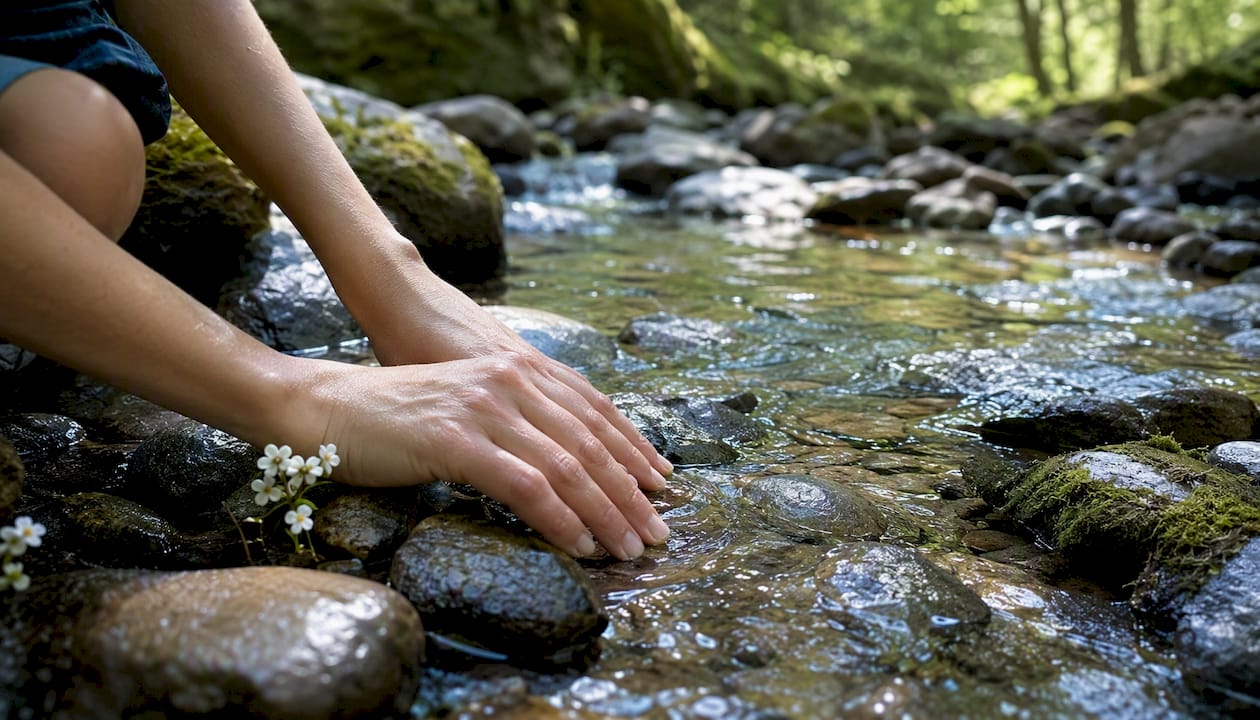
Picture yourself standing at the edge of a quiet forest path. The light filters through the trees in long, soft beams. The air is cool and smells faintly of pine and earth. You hear birds somewhere above you, and the distant sound of water moving over rocks.

Begin walking slowly along the path. Feel the ground beneath your feet, firm and steady. Notice the texture of the bark on the trees as you pass. The sound of the water grows slightly louder. You reach a small clearing where a shallow stream runs over smooth stones. Sit down on a flat rock beside the water.
Watch the water move. Notice how it catches the light. Feel the warmth of the sun on your face and the coolness of the air around you. Your breathing is slow and even. Your shoulders are relaxed. Your hands are loose in your lap.
Stay here for as long as you need. When you are ready to return, take one slow breath, wiggle your fingers and toes, and gently open your eyes.
10–15 minute therapist-style script
This script follows the NIMH guided visualization format and adds progressive relaxation and post-session reinforcement.
Opening (2 min): Settle into your position. Take five slow breaths, each exhale twice as long as the inhale. With each breath out, let your body become heavier and more relaxed. Scan from your feet to your head, releasing tension as you go.
Scene entry (3–4 min): Picture a place where you have felt genuinely at peace. It can be real or imagined. Step into that place. Look around slowly. What is the first thing you see? What is the quality of the light? What sounds are present? What does the air smell like? What does the ground or surface feel like beneath you?
Deepening (4–5 min): Move through the space slowly. Touch something in the scene, a surface, a leaf, the water. Notice its texture and temperature. Find a comfortable place to sit or lie down within the scene. Let your body fully relax into it. Your heart rate is slow. Your breathing is easy. Your mind is quiet.
Reinforcement (2 min): While you are in this calm state, repeat silently to yourself: "I am calm. My body knows how to relax. I can return to this state whenever I choose." Let those words settle into your body, not just your mind.
Return (1–2 min): Take three slow breaths. Begin to feel the room around you. Wiggle your fingers and toes. Gently open your eyes. Sit quietly for one minute before moving.
Personalizing your scenes: If a scene unexpectedly triggers discomfort, swap it immediately for a neutral one. Some people find open water or heights activating rather than calming. If visual imagery is weak for you, anchor to sound or physical sensation instead. For public speaking anxiety, for example, a useful scene might be a quiet room before a performance, not the stage itself.
- Avoid scenes linked to past trauma, even indirectly.
- If you are a strong auditory processor, build the scene through sound first.
- If you are somatic, start with physical sensations: temperature, weight, texture.
How often should you practice and in what format?
Three formats exist, and the right one depends on your goal and current anxiety level.
| Format | Best for | Typical session length | Frequency | Clinician needed? |
|---|---|---|---|---|
| Self-guided (audio recording) | Daily maintenance, beginners | 10–20 min | Daily | No |
| Self-guided (silent, from memory) | Experienced practitioners, acute coping | 1–15 min | As needed or daily | No |
| Clinician-led (hypnotherapist) | Deeper change, trauma-adjacent anxiety, phobias | 20–40 min | Weekly or biweekly | Yes |
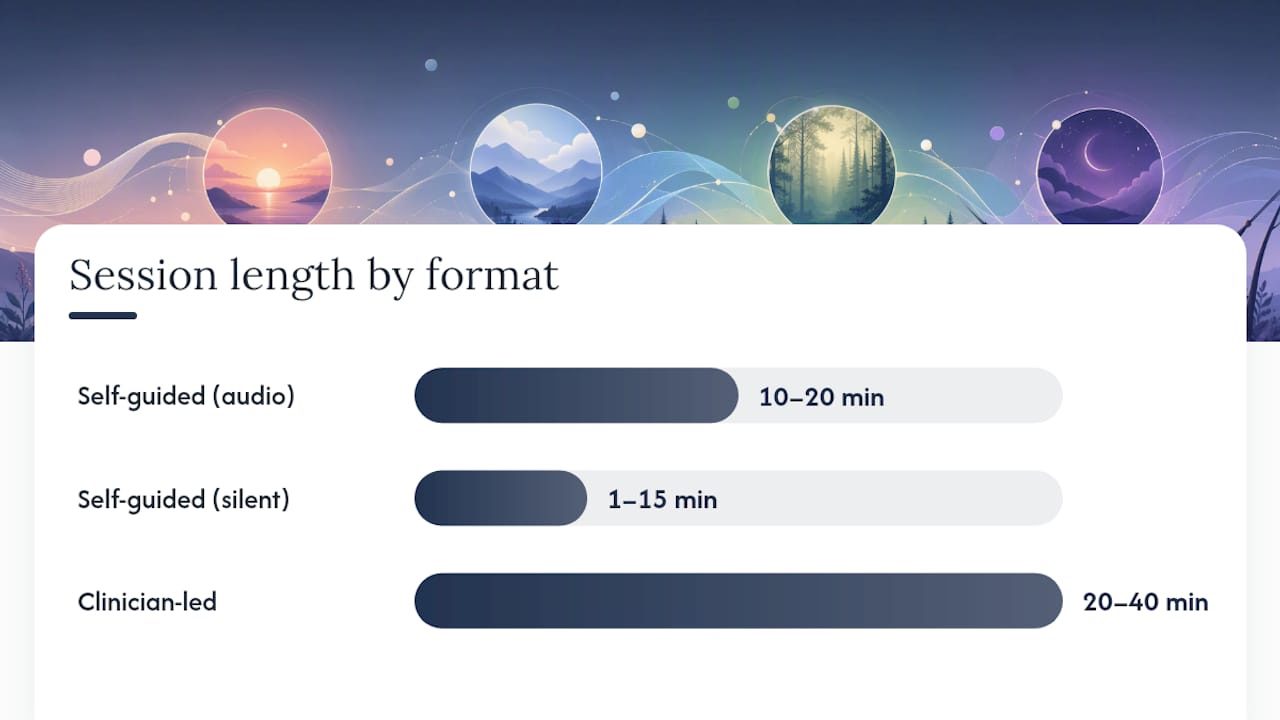
For acute coping, the micro-practice (30–90 seconds) is enough to interrupt a spike. For daily anxiety maintenance, a 10–15 minute audio session each morning or evening builds a cumulative calming effect on the nervous system. For clinical-level change, such as reducing a phobia or breaking a chronic anxiety pattern, weekly clinician-led sessions are more effective than self-practice alone, particularly when the clinician integrates hypnosis, visualization, and post-hypnotic suggestions to reinforce the work between appointments.
Pairing imagery with CBT tools strengthens outcomes. Cognitive restructuring addresses the thought patterns that feed anxiety; imagery addresses the physiological state those thoughts produce. Mindfulness practices, particularly body-scan meditation, complement imagery by training the same attentional focus skills. The combination of all three tends to produce more durable relief than any single approach.
Practical habit tips:
- Attach your imagery practice to an existing habit: right after waking, before a meal, or before sleep.
- Keep a simple log: date, session length, and a 1–10 anxiety rating before and after. Patterns become visible within two weeks.
- Use a consistent audio recording for the first month to reduce the cognitive load of building the scene from scratch each time.
Who should not use guided imagery alone?
Guided imagery is safe for most people, but it is relatively contraindicated for certain conditions. Clinical guidance from the Palliative Care Network of Wisconsin explicitly lists the following as contraindications or conditions requiring professional supervision:
- Active hallucinations or delusions. Imagery can intensify or blur the line between internal experience and reality.
- Delirium. The altered cognitive state makes guided practice unsafe without clinical oversight.
- Severe OCD. Imagery can inadvertently reinforce intrusive thought loops.
- Active PTSD with flashback risk. Sensory imagery may trigger involuntary trauma re-experiencing.
- Active suicidal ideation or severe depression. Professional supervision is required before any self-guided practice.
Guided imagery is relatively contraindicated for patients with hallucinations, delusions, delirium, severe OCD, and those at risk of flashbacks; professional supervision is recommended for patients with active depressive thoughts. — Palliative Care Network of Wisconsin, Clinical Guidance
Rare adverse reactions do occur in the general population. Some people experience increased anxiety, dissociation, or unexpected emotional release during imagery. These reactions are more common in people with trauma histories and are manageable with a trained clinician present.
Pre-practice safety checklist:
- No active hallucinations or delusions today.
- No current delirium or acute confusion.
- Willing and able to open eyes and stop the practice immediately if distressed.
- Have a therapist's contact or a crisis line number available.
- Avoiding scenes with any sensory content linked to known trauma.
For trauma-sensitive practice, use only neutral, non-specific scenes. A plain room with soft light, a gentle color gradient, or an abstract warm space works better than nature scenes that might carry unintended associations. Keep sessions short (under five minutes) until you have established that the practice is consistently calming for you.
When should you work with a clinical hypnotherapist?
Self-guided imagery handles mild to moderate situational anxiety well. Seek a trained clinician when any of the following apply:
- Imagery sessions consistently increase distress rather than reduce it.
- You experience repeated flashbacks or intrusive images during or after practice.
- Panic attacks are worsening or becoming more frequent.
- You cannot stop negative imagery once it starts.
- Anxiety is significantly interfering with work, relationships, or daily function.
- Suicidal ideation is present at any level.
When self-guided practice reliably increases distress or triggers flashbacks, continuing without professional support is not a safe option. A trained clinician can manage adverse reactions in real time and adjust the approach to your specific nervous system response. — Palliative Care Network of Wisconsin, Clinical Guidance
A Certified Clinical Hypnotherapist (CCHt) brings specific tools that self-practice cannot replicate. These include a structured hypnotic induction that deepens the relaxation state before imagery begins, somatic anchoring techniques that link a physical cue (a touch or a breath) to the calm state so that it can be recalled quickly outside sessions, and post-hypnotic suggestions framed to extend the session's effect into daily life. The clinician also monitors for adverse reactions and adjusts the script in real time.
In a first session with a hypnotherapist, expect a detailed intake covering your anxiety history, triggers, and any contraindications. The session itself typically runs 45–60 minutes and includes the induction, imagery work, and a debrief. Ask about the clinician's credentials (CCHt from an accredited body), their experience with anxiety and phobias specifically, and whether they integrate CBT or other evidence-based frameworks alongside hypnosis.
Clinician-led sessions also integrate well with psychiatric medication and psychotherapy. Imagery and hypnosis do not replace medication for clinical anxiety disorders; they work alongside it by addressing the subconscious patterns and physiological habits that medication alone does not retrain.
Pro Tip: In a clinician-led session, the imagery portion typically begins 10–15 minutes into the session, after the induction has deepened the relaxed state. This is meaningfully different from self-guided practice, where you enter imagery from a normal waking state. The deeper starting point allows for more precise post-hypnotic reinforcement.
Common mistakes beginners make with guided imagery
Most people who try guided imagery once and decide it "didn't work" made one of these errors.
Common mistakes:
- Staying too shallow. Picturing a scene without adding sensory layers. A flat image produces a flat physiological response. Add sound, temperature, and texture.
- Ignoring body cues. Skipping the body scan or grounding step and jumping straight to the scene. The nervous system needs a physical anchor before imagery can deepen.
- Sessions that are too long, too soon. Starting with a 20-minute session before you have practiced the basics. Fatigue and frustration set in. Start with five minutes and build.
- Using scenes with hidden triggers. A beach that reminds you of a difficult event, or a forest that feels isolating. Test scenes in short bursts before committing to them.
- Treating it as passive. Waiting for the imagery to "happen to you." Active, deliberate construction of sensory detail is what produces the physiological shift.
Tips to strengthen your practice:
- Add one new sensory layer per session until you are engaging at least four senses.
- If visual imagery is weak, start with sound. Build the scene through what you hear before adding what you see.
- For people with aphantasia (the inability to form mental images), visual detail is not required. Use conceptual anchors, emotional impressions, or physical sensations like warmth, weight, or texture to elicit the same relaxation response.
- Practice at the same time each day for the first two weeks. Consistency trains the nervous system to enter the relaxed state more quickly.
Pro Tip: Rate your anxiety on a 1–10 scale immediately before and after each session and write it down. After two weeks, the pattern tells you whether the practice is working and which session lengths produce the strongest shift. This data also helps a clinician calibrate your sessions if you move to professional support.
A clinician's perspective on guided imagery and hypnotherapy
Most articles about guided imagery treat it as a standalone relaxation tool. That framing undersells what it actually does, and it also misses where the technique falls short on its own.
The reason imagery works is not that it distracts you from anxiety. It works because the subconscious mind does not sharply distinguish between a vividly imagined experience and a real one. When you build a multisensory calming scene with enough detail, your nervous system begins to respond to it as though you are actually there. Heart rate drops. Cortisol production slows. The fight-or-flight loop loses its grip. That is a real physiological event, not a placebo.
The limitation of self-guided practice is depth. Most people, practicing on their own, stay in a light focused-attention state. That is enough for mild anxiety and daily maintenance. For anxiety rooted in a specific subconscious pattern, a phobia, a conditioned panic response, or a fear that has been running on autopilot for years, the light state rarely reaches deep enough to rewrite the pattern.
This is where hypnotherapy changes the equation. A structured induction takes the nervous system to a deeper state of focused relaxation before imagery begins. At that depth, the subconscious is more receptive to new associations. Post-hypnotic suggestions, framed in present-tense language, are introduced to carry the calming response forward into daily life. The imagery becomes an anchor, not just a temporary relief. Clients who combine weekly clinician-led sessions with daily short self-practice between appointments tend to see faster and more durable change than those using either approach alone.
The PAS framework driving this page is intentional. The problem is anxiety that keeps firing even when there is no real threat. The agitation is the nervous system stuck in a loop it cannot exit on its own. The solution is a practice that speaks the language the nervous system actually responds to: vivid, sensory, present-tense experience. Guided imagery does that. Hypnotherapy does it at a deeper level, with professional guidance to ensure it holds.
Ready to work with a clinical hypnotherapist for anxiety?
Self-guided imagery is a solid starting point. When the anxiety is deeper, more persistent, or tied to specific triggers your nervous system keeps returning to, a clinician-led approach produces more targeted and lasting results.
Hypnotictransformations offers online hypnotherapy for anxiety via Zoom, led by Kirk Hoffman, Certified Clinical Hypnotherapist. Sessions run 45–60 minutes and combine structured hypnotic induction, multisensory guided imagery, somatic anchoring, and post-hypnotic reinforcement. All sessions are confidential. A free consultation is available to discuss your specific anxiety pattern and what a course of sessions would address. To schedule, visit the appointments page and choose a time that works for you.
Sources
The sources below are the clinical and authoritative references used throughout this article. They cover the evidence base, practical scripts, contraindications, and session formats discussed above.
- Guided Imagery for Anxiety - Palliative Care Network of Wisconsin
- Guided imagery for anxiety disorder: Therapeutic efficacy and changes in quality of life
- Imagery | Johns Hopkins Medicine
- Guided Visualization: Dealing with Stress
- Guided Imagery: How To and Benefits for Sleep, Anxiety, More
This article provides general information about guided imagery and is not a substitute for professional mental health advice. If you are experiencing severe anxiety, suicidal ideation, or symptoms of a psychiatric condition, consult a licensed mental health professional or contact a crisis line.