
Grief hypnosis can lower the physical alarm state that keeps you stuck in raw, early grief, and it can reduce intrusive images and improve sleep when a trained clinician delivers it. It is not a fast cure for major depression, and it is not the right first step if you are having thoughts of suicide. A 2025 randomized trial found Ericksonian Hypnotherapy reduced prolonged grief symptoms about as well as Cognitive Behavioral Therapy, sometimes slightly better in that sample, and a published case report describes a patient resolving prolonged grief after a structured course of sessions.
What to do right now, before anything else:
- If you're in acute distress today, try a short grounding practice (covered later in this piece) instead of searching for a quick fix.
- If sleep loss, intrusive memories, or numbness have lasted more than a few weeks, look for a certified clinical hypnotherapist rather than a free audio track.
- If you're having thoughts of self-harm, call or text 988 in the US right now. Hypnotherapy is not an emergency intervention.
A quick number worth sitting with: in that same 2025 trial, both treatment groups significantly outperformed a control group on standard grief measures. Neither approach is a miracle, but neither is placebo either. Clinicians like Kirk Hoffman at Hypnotic Transformations use these same Ericksonian-informed methods in structured online sessions.
Key Takeaways
Grief hypnotherapy, delivered by a trained clinician using Ericksonian technique, can measurably reduce prolonged grief symptoms and calm the physical stress response tied to painful memories, but it works best alongside other care for severe or complicated cases.
| Point | Details |
|---|---|
| Evidence base is real but young | A 2025 randomized trial showed Ericksonian Hypnotherapy and CBT both significantly reduced grief symptoms versus a control group. |
| Case reports show long-arc results | A published case report documented resolution of prolonged grief and maladaptive coping after a structured 40-session course. |
| Technique depends on the person | Ericksonian, Safe Harbor, letter technique, and continuing bonds approaches get chosen based on how raw the memory still feels. |
| Know the red flags | Active psychosis, uncontrolled substance withdrawal, and suicidal ideation require psychiatric or medical care first, not hypnotherapy. |
| Hypnotic Transformations offers a vetted path | Kirk Hoffman, CCHt, delivers online grief-focused sessions using Ericksonian-informed technique with a free consultation to start. |
Table of Contents
- What Is Grief Hypnosis and How Does It Work?
- Does Grief Hypnotherapy Actually Work? What the Research Shows
- What Techniques Do Hypnotherapists Use for Grief?
- Who Benefits Most, and When Should You Be Cautious?
- What Happens in a Grief Hypnotherapy Session?
- Simple Self-Hypnosis Exercises You Can Try Today
- What Credentials Should Your Grief Hypnotherapist Have?
- How Grief Actually Moves Through the Mind
- Grief Hypnosis vs. CBT and Traditional Counseling
- What Ethical Standards Apply to Grief Hypnotherapy?
- An Honest Take on Where Grief Hypnosis Fits
- Ready to Work Through Grief With Guided Support?
- Frequently Asked Questions
- Sources
What Is Grief Hypnosis and How Does It Work?
Grief hypnosis, more precisely called grief hypnotherapy, is a focused state of attention a trained clinician guides you into so your nervous system can process loss without the usual defensive noise getting in the way. You stay aware the entire time. You are not asleep, you are not unconscious, and you do not lose control of what you say or do. If anything feels wrong, you can open your eyes and stop the session yourself.
Here's the mechanism in plain terms. Grief often gets stuck because the thinking part of your brain, the prefrontal cortex, keeps interrupting the emotional processing that needs to happen in the limbic system. You intellectualize. You distract yourself. You stay busy. Hypnosis quiets that cortical interference just enough to let the limbic system do its job: reprocess the emotionally loaded memory, lower the fight-or-flight charge attached to it, and file it as painful history instead of a live threat. That's why people often report feeling physically lighter after a session, not just "better" in some vague emotional sense.
This differs meaningfully from a generic guided meditation app:
- A recorded meditation is one-size-fits-all; a clinical session is built around your specific loss, your specific triggers, and your specific coping patterns.
- A trained hypnotherapist checks in during the session (through simple ideomotor signals, more on that later) to make sure the pace is safe.
- A clinician can adjust technique in real time if a memory surfaces that's more traumatic than expected. An app cannot.
- Clinical sessions are typically recorded for you specifically, so your at-home practice reinforces work that's already been calibrated to your nervous system.
Guided audio for general relaxation has a place. It is not the same tool as trauma and grief hypnosis delivered by someone trained to recognize when a memory needs careful handling.
Does Grief Hypnotherapy Actually Work? What the Research Shows
The strongest piece of evidence right now is a 2025 randomized clinical trial comparing Ericksonian Hypnotherapy directly against Cognitive Behavioral Therapy for prolonged grief. Both treatment arms showed a statistically significant drop in grief symptoms compared with an untreated control group. Ericksonian Hypnotherapy edged out CBT slightly in that particular sample, though the researchers were careful to note this needs replication in larger groups before anyone calls it definitive.
The number that matters most here isn't a percentage, it's the comparison group. Untreated grief symptoms in the control arm didn't show the same drop. That's the part skeptics of hypnotherapy tend to miss: this wasn't hypnosis versus nothing, it was hypnosis holding its own against an established, evidence-backed talk therapy.
The second major piece of evidence is a published case report describing clinical hypnotherapy resolving prolonged grief in a patient who had developed alcohol dependence as a coping mechanism after loss. Over a structured 40-session course, the patient reduced maladaptive drinking, resumed daily functioning, and moved toward accepting the loss rather than avoiding it. Case reports don't prove causation the way randomized trials do, but they show clinicians exactly what a real treatment arc looks like, session by session, symptom by symptom.
What do clinicians actually track as progress? Typically:
- Sleep quality and duration
- Frequency and intensity of intrusive memories or images
- Return to routine daily activities (work, meals, social contact)
- Reduction in avoidance behaviors
- Self-reported acceptance of the loss
Timelines vary. Situational grief that hasn't calcified into avoidance patterns can shift in a handful of sessions. Prolonged Grief Disorder, where symptoms have persisted for a year or more with significant impairment, usually needs a longer course, closer to what that case report described. The honest limitation across this research: sample sizes remain small, and larger trials are still needed before grief hypnotherapy earns a place next to CBT as a first-line, guideline-recommended treatment. Modern clinical reviews argue that traumatic grief specifically often requires accessing the trauma itself before ordinary mourning can even begin, which is exactly the gap hypnotic techniques are built to close.
What Techniques Do Hypnotherapists Use for Grief?
Not every grief case gets the same technique. A trained clinician chooses based on how raw the memory still is, whether the client can tolerate direct recall, and what specific symptom is driving the most day-to-day suffering.
- Ericksonian and permissive techniques. These use indirect language, metaphor, and story rather than direct instruction. If a client flinches at the idea of "remembering the funeral," an Ericksonian approach might talk about "a room where difficult things get put down for a while," letting the subconscious mind find its own way in without the conscious mind bracing against it. This method suits clients who are overwhelmed by direct recall or who intellectually resist hypnosis as a concept.
- Safe Harbor technique. This is a rapid nervous-system regulation tool, essentially a mental location the client builds in advance that the body associates with calm. When intrusive grief images surface mid-session or mid-day, the client returns to this internal anchor point to bring arousal back down before continuing.
- Letter technique. The client mentally composes or speaks a letter to the person who died, saying what went unsaid. This directly addresses unresolved business, one of the most common drivers of stuck grief.
- Continuing bonds work. Rather than trying to "let go," this approach helps the client restructure their relationship with the deceased into something sustainable, a source of comfort instead of a wound. Structured techniques like this aim for integration, not erasure of memory.
- Future progression and memory reconsolidation. For traumatic imagery (a sudden death, an accident, a hospital scene that keeps replaying), the clinician guides the client to revisit the memory with new resources attached, physical calm, adult perspective, distance, so the memory gets re-filed with a lower emotional charge attached to it.
Ericksonian methods in particular have become a preferred first approach for complicated grief precisely because they don't force the client to confront anything before they're ready.
Pro Tip: If a hypnotherapist starts every session with direct, blunt instructions to "picture the moment they died," that's a sign they may not be trained in trauma-informed technique. Ask what approach they use before booking.
Who Benefits Most, and When Should You Be Cautious?
Grief hypnotherapy tends to help most when the picture looks like this: intrusive images that won't stop replaying, sleep that's been disrupted for weeks or months, and avoidance behaviors that are shrinking your life (skipping places, people, or routines tied to the loss). The typical goal isn't to forget. It's to lower the charge on the memory enough that daily functioning comes back online.
There are real limits here, and they matter:
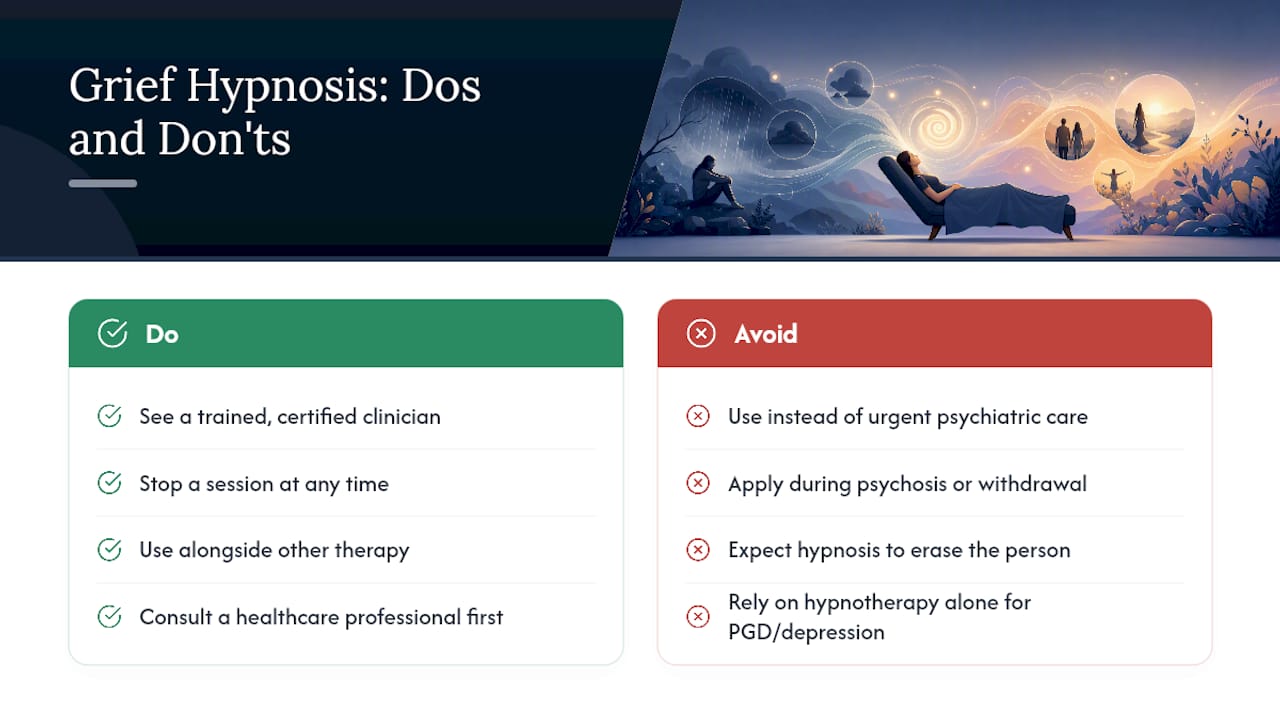
- Active psychosis or a current manic episode is not a scenario for hypnotherapy; stabilization comes first.
- Uncontrolled substance use or withdrawal needs medical management before hypnotic work can be safely layered in.
- Imminent suicidal ideation is a psychiatric emergency, not a hypnotherapy session. Call 988 or go to an emergency room.
Grief hypnotherapy often works best paired with other care, not instead of it. Hypnotherapy tends to function best as an integrative tool rather than a standalone fix once someone meets diagnostic criteria for major depression or Prolonged Grief Disorder. A hypnotherapist working alongside a psychiatrist, a CBT-trained therapist, or a physician managing medication is the safest and most effective combination for anything beyond situational, uncomplicated grief.
What Happens in a Grief Hypnotherapy Session?
Sessions generally move through recognizable stages, and knowing them in advance takes the mystery (and some of the anxiety) out of the process.
- Light induction. A few minutes of guided relaxation, slower breathing, muscle release. You're still fully alert and talking normally at this stage.
- Medium depth. Attention narrows. The clinician checks depth using ideomotor signaling, small, involuntary finger movements that answer "yes" or "no" questions without you having to speak or break focus.
- Deep work. This is where memory reconsolidation, Safe Harbor installation, or letter-technique work actually happens, depending on what the session is targeting.
- Return and grounding. The clinician brings you back to full alertness gradually, checks in verbally, and confirms you feel oriented before ending the session.
Most clinicians record the session audio so you can use it for daily self-practice between appointments. One important safety rule: never listen to a hypnotic recording while driving or operating machinery, only in a seated or lying position where you can fully relax.
How many sessions does this take? Situational grief without complicating trauma often responds within four to six sessions. Prolonged Grief Disorder, where symptoms have persisted well past a year, typically needs a longer arc, closer to the extended course described in the published case report on hypnotherapy for grief resolution.
Simple Self-Hypnosis Exercises You Can Try Today
These are safe, brief practices, not a replacement for clinical work, but a way to lower arousal in the moment and understand what grief hypnosis actually feels like from the inside.
- Three-minute grounding script. Sit somewhere quiet. Breathe in for four counts, hold for four, breathe out for six. Repeat five times. Then scan your body from feet to head, naming one physical sensation in each area (tension, warmth, heaviness) without trying to change it. This alone measurably lowers autonomic arousal within a few minutes.
- Safe Harbor visualization. Picture a specific place, real or imagined, where you have felt completely safe. Notice three details: what you see, what you hear, what you feel against your skin. Hold that image for sixty seconds. This becomes your anchor.
- Install the anchor. While holding the Safe Harbor image at its most vivid, press your thumb and index finger together gently. Repeat this pairing three times. Over the next week, whenever grief spikes, press the same two fingers together to recall the calm state faster.
- Recording guidance. If you record yourself reading a grounding script aloud, keep it under five minutes, speak slowly, and only play it back seated or lying down in a private space.
Pro Tip: Set a stop rule before you start: if a memory surfaces that feels too intense to sit with alone, open your eyes, name three objects in the room out loud, and stop the exercise. That's not failure, that's your nervous system telling you this particular memory needs a trained clinician in the room.
For a longer walkthrough of building these anchors into a daily habit, see this guide to self-hypnosis practice, and for grief specifically paired with self-compassion work, this loving kindness hypnosis guide covers a gentler entry point.
What Credentials Should Your Grief Hypnotherapist Have?
Kirk Hoffman, a Certified Clinical Hypnotherapist (CCHt), delivers grief-focused sessions through Hypnotic Transformations entirely online, using Ericksonian-informed techniques alongside NLP and guided imagery tailored to each client's specific loss and symptom pattern.
Before booking anyone, confirm these basics:
- A recognized certification (CCHt or equivalent) from an accredited hypnotherapy training body.
- Clear scope of practice: a hypnotherapist should be upfront about referring out to psychiatry or trauma therapy when symptoms exceed their scope.
- A free consultation offered before you commit to a paid package, so you can assess fit without financial pressure.
- Session structure explained in advance (how many sessions, what a typical arc looks like for your situation).
Hypnotic Transformations offers free initial consultations and multi-session packages built around the client's specific goals, delivered by video call, which removes geography as a barrier entirely.
How Grief Actually Moves Through the Mind
Grief isn't a straight line, and the old five-stage model (denial, anger, bargaining, depression, acceptance) was never meant to describe a fixed sequence everyone marches through in order. Most people cycle through waves: a calm week, then a bad afternoon triggered by a song or a smell, then calm again. What actually predicts a stuck grief process isn't which "stage" someone is in, it's whether the nervous system keeps getting hijacked by the same unprocessed memory over and over.

This is where hypnosis interacts directly with the grief process rather than sitting outside it. When a memory stays fully "hot," meaning it still triggers the same fight-or-flight spike months later, ordinary mourning can't complete because the body treats the memory as an active threat rather than a settled loss. Experts studying traumatic grief point out that this trauma layer often has to be addressed directly before normal grieving can resume at all.
Hypnotherapy doesn't skip stages or force acceptance on a timeline. It targets the specific mechanism, an overactive stress response tied to a specific memory, that keeps someone circling the same painful loop. Once that charge comes down, the natural movement toward acceptance tends to resume on its own, because the nervous system is no longer fighting the process.
Grief Hypnosis vs. CBT and Traditional Counseling
CBT for grief focuses on identifying and restructuring unhelpful thought patterns: catastrophic thinking, self-blame, avoidance rationalizations. It's structured, often homework-based, and works primarily through the conscious, analytical mind. Traditional grief counseling leans more on talking through the loss, building support, and normalizing the emotional experience over time, usually without a specific technique for handling intrusive memories directly.
Grief hypnotherapy works differently at the mechanism level. Instead of restructuring thoughts about the memory, it changes how the memory is stored and how strongly it triggers the body's stress response. That's a meaningful distinction for someone whose main problem isn't distorted thinking, it's a body that still reacts to a photograph or a voicemail the same way it did the week after the loss.
Neither approach is strictly superior across the board. The randomized trial comparing Ericksonian Hypnotherapy against CBT found both produced significant improvement, with EH performing slightly better in that particular sample. Many clinicians see these as complementary rather than competing: CBT for the thought patterns keeping someone stuck in guilt or blame, hypnotherapy for the raw physiological charge attached to specific memories. A local therapy practice like Your Family Walk-in Clinic can be a useful complement for talk-based support alongside hypnotherapy sessions focused specifically on memory processing.
What Ethical Standards Apply to Grief Hypnotherapy?
Grief is one of the most vulnerable states a person experiences, and that vulnerability creates specific ethical obligations for anyone practicing hypnotherapy in this space.
Informed consent has to be explicit and ongoing. A client should understand, before any induction begins, that they remain aware and in control throughout, that they can stop at any point, and what the session will actually target. Ethical practitioners never suggest a hypnotic session can "erase" grief or "remove" someone from your memory. That's not how the technique works, and claiming otherwise misleads a client at their most vulnerable.
Scope of practice matters just as much. A hypnotherapist without psychiatric training has an ethical obligation to screen for major depression, suicidal ideation, and psychosis, and to refer out immediately when any of those appear rather than attempting to treat them with hypnotic technique alone. Continuing bonds work in particular carries a specific ethical risk: a poorly trained practitioner could nudge a grieving client toward believing they're literally communicating with the deceased rather than symbolically processing the relationship. Ethical practice keeps that distinction clear at every step.
Finally, false memories are a genuine risk in any hypnotic work involving memory. A well-trained clinician avoids leading questions during recall and never implants details the client didn't originate themselves.
An Honest Take on Where Grief Hypnosis Fits
The research on grief hypnotherapy doesn't support the breathless claims some corners of the internet make about it. It's not a cure. What it actually does, based on the trial data and the case report, is give clinicians a systematic way to lower a nervous system's alarm state around a specific memory, which then lets normal mourning resume. That's a narrower claim than "healing your grief," and it's a more honest one.
Where conventional advice falls short is treating grief like a single emotional problem with a single emotional fix. Talk about it more. Journal. Give it time. Those help plenty of people. They don't address a body that still spikes adrenaline every time a certain song plays, months after the funeral. That's a nervous system problem, not a willpower problem, and it needs a technique built for the nervous system.
If you take one thing from this article, take this: notice whether your grief is mostly emotional or mostly physical and intrusive. The second kind is where hypnotherapy earns its place fastest.
Ready to Work Through Grief With Guided Support?
If you've read this far, you already know grief hypnotherapy isn't a script you download and play on repeat. It's a structured process, calibrated to your specific loss, delivered by someone trained to recognize when a memory needs careful handling versus when it's safe to move through quickly. That calibration is exactly what separates a real clinical session from a generic relaxation track, and it's the gap Hypnotic Transformations exists to close.
Kirk Hoffman, a Certified Clinical Hypnotherapist, works with clients nationwide over video call using the same Ericksonian-informed techniques described throughout this piece: memory reconsolidation, Safe Harbor installation, and continuing bonds work, chosen based on your specific symptoms rather than a one-size-fits-all script. Sessions are recorded for you individually so your at-home practice is reinforced by work already tailored to your nervous system, and multi-session packages are built around situational grief or longer-standing Prolonged Grief Disorder as needed. Start with a free consultation to talk through what you're carrying and whether hypnotherapy is the right next step for your specific situation.
Frequently Asked Questions
Is grief hypnosis safe? Yes, when delivered by a trained, certified clinician. You remain aware and in control throughout, and you can stop a session at any point. It becomes unsafe only when used as a substitute for urgent psychiatric care in cases of active psychosis, uncontrolled substance withdrawal, or suicidal ideation.
How is grief hypnotherapy different from hypnosis for other issues, like anxiety? The underlying trance state is similar, but the target is different. Hypnotherapy for anxiety and depression typically works on general fear responses and thought loops, while grief hypnotherapy targets specific loss-related memories and the physical charge attached to them.
Can hypnosis make me forget the person I lost? No. Techniques like the letter method and continuing bonds work aim to restructure your relationship with the memory, not erase it. The goal is a memory that no longer triggers the same fight-or-flight spike, not a blank space where the person used to be.
How many sessions does grief hypnotherapy usually take? Situational grief without complicating trauma often responds within four to six sessions. Prolonged Grief Disorder, with symptoms lasting over a year, typically needs a longer course, similar to the extended arc described in the published case report on hypnotherapy for grief resolution.
Should I try hypnosis instead of therapy, or alongside it? Alongside it, in most cases. Hypnotherapy tends to work best as one part of an integrated care plan, particularly when depression or Prolonged Grief Disorder is also present, rather than as a standalone replacement for psychiatric or psychological care.
This article is general information, not a substitute for advice from a qualified doctor. Consult a qualified healthcare professional about your own circumstances before acting on anything here.
Sources
- Effects of Ericksonian Hypnotherapy Versus Cognitive Behavioral Therapy on Prolonged Grief: randomized clinical trial
- Clinical Hypnotherapy in Grief Resolution - A Case Report
- Transforming grief into peace: The normal grieving mind