Hypnosis helps many people with acrophobia by interrupting the automatic fall imagery that triggers panic before it takes hold. Your best first move depends on severity: book a consultation with a certified clinical hypnotherapist for structured sessions, or start with an evidence-aligned audio track paired with gradual exposure if your fear is mild to moderate. Expect noticeable change within four to eight sessions or weeks of consistent audio practice, not overnight relief. If panic includes chest pain or fainting, see a doctor first.
TL;DR:
- Hypnosis targets the automatic fall imagery triggering height fear by inducing relaxation, imaginal exposure, reinterpretation of bodily cues, and anchoring calm responses.
- Moderate effectiveness is supported by a 2017 trial, with about one-third of participants improving within eight weeks after a single brief session.
- Sessions typically last 15 to 20 minutes, focus on mental rehearsal of height scenarios, and include homework like real-world exposure or practicing calming cues.
- Audio recordings can help for mild fears but are usually insufficient alone for panic-level symptoms, requiring clinician oversight and structured content.
- Combining hypnotherapy with gradual exposure and real-world practice offers the best chance for meaningful, lasting reduction in acrophobia.
Table of Contents
- How Does Hypnosis Reduce a Fear of Heights?
- What Does the Research Say About Hypnosis for Acrophobia?
- What Happens in a Hypnotherapy Session for Height Fear?
- Can Hypnosis Audio Help With Fear of Heights on Its Own?
- How Do You Choose a Hypnotherapist for Height Phobia?
- A Clinician's Note on Treating Height Fear
- What the Research Actually Supports, and Where Common Advice Falls Short
- Ready to Book a Session for Fear of Heights?
- Sources
- FAQ
How Does Hypnosis Reduce a Fear of Heights?
Acrophobia usually runs on a loop. You look down, your mind flashes an image of falling, your body reads that image as real danger, and your nervous system fires the fight-or-flight response before you've consciously decided anything. Hypnosis works by getting in front of that loop, not after it.
A hypnotherapist first guides you into a relaxed, focused state where your body's stress response quiets down. From there, the work targets the automatic imagery directly.
- Relaxation induction: slows breathing and heart rate so the nervous system isn't primed for panic before exposure work starts.
- Imaginal exposure: you picture height scenarios in gradual steps while staying calm, which is the same skill the 2017 Arroll et al. randomized controlled trial tested.
- Reinterpreting bodily cues: a racing heart on a balcony gets relabeled as excitement or alertness instead of a danger signal.
- Anchor installation: pairing a physical cue, like pressing thumb and finger together, with a calm state you can trigger on demand.
- Rehearsal: mentally walking through a real situation, such as a hotel balcony or a glass elevator, before you face it.
None of this replaces real-world practice. Clinicians pair the trance work with gradual, in-person exposure and simple breathing drills, because the brain needs both the mental rehearsal and the lived proof that heights don't equal danger.
Pro Tip: Practice the anchor gesture during a calm moment at home first. If you only ever use it during panic, your nervous system won't have learned to associate it with calm.
What Does the Research Say About Hypnosis for Acrophobia?
A 2017 randomized controlled trial of a brief imaginal intervention found that a significant proportion of participants showed clinically significant improvement at eight weeks, compared with fewer in the control group. The number needed to treat was calculated as about six, indicating moderate effectiveness of the intervention.
Approximately a third of participants improved within eight weeks of a single brief imaginal session, notably more than the control group's rate.
The journal report itself describes the approach as probably effective, brief, and safe, and suggests it as a reasonable step before committing to longer exposure therapy programs. That's a modest, honest claim, not a cure-all.
- A newer Clinicaltrials is testing whether combining trance induction with VR-based height exposure up to 60 meters outperforms exposure alone.
- These trials track subjective fear ratings and hypnotic depth across sessions, not just one-time outcomes.
The honest read: hypnosis-based imaginal work has real, measured support, but effect sizes are moderate. It's one solid tool, not a guaranteed fix for everyone.
What Happens in a Hypnotherapy Session for Height Fear?
Your first session is mostly conversation. The clinician asks about when the fear started, what specifically triggers it (bridges, ladders, glass floors, flying), what you've already tried, and screens for panic disorder or other conditions that need separate medical attention.
- Assessment: history, triggers, and screening questions, usually 15 to 20 minutes.
- Induction: a guided relaxation process that shifts you into a calm, focused state.
- Imaginal exposure: stepping through height scenarios mentally, starting mild and building up.
- Anchor installation: locking in a physical cue tied to the calm state.
- Homework: a specific real-world step to try before the next session, like standing near a second-floor window.
Most clients notice a difference in how fast their fear response fades within four to eight sessions, though some people feel a shift after one focused session. Signs it's working: you catch yourself before the fall imagery spirals, or your heart rate settles faster once you're at height.
- Session frequency is usually weekly, sometimes every other week once you're doing well.
- If you experience chest pain, fainting, or panic attacks unrelated to heights, that's a signal to loop in a licensed mental-health clinician alongside hypnotherapy, not instead of it.
Can Hypnosis Audio Help With Fear of Heights on Its Own?
Audio recordings work well for mild to moderate fear, especially as a way to reinforce what you learn in sessions or as a lower-cost starting point. If your fear includes full panic attacks, fainting, or you avoid entire categories of daily activity because of it, audio alone usually isn't enough. That level calls for a clinician who can screen you properly first.
Not all recordings are built the same way. Before you commit to one, check for these:
- Author credentials: is it made by a licensed or certified hypnotherapist, not an anonymous script?
- Structure: does it include actual imaginal exposure steps, or is it just generic relaxation?
- Length: most effective tracks run 20 to 30 minutes, long enough to reach a working trance state.
- Anchor content: does it teach you a calming cue you can use outside the recording?
Pro Tip: Listen at the same time each day, ideally somewhere quiet where you won't be interrupted, and pair it with one small real-world height exposure that same week. The audio without the practice rarely sticks.
How Do You Choose a Hypnotherapist for Height Phobia?
Not every hypnotherapist has real experience with phobias specifically. Ask direct questions before you book anything.
- Do they hold a Certified Clinical Hypnotherapist credential or an equivalent clinical license?
- Have they treated acrophobia or similar specific phobias before, and what does a typical plan look like?
- What outcomes do they track, and how do they measure progress across sessions?
- Is there follow-up support if the fear returns after a stressful event?
Watch for red flags. A guaranteed cure in one session, no questions about panic history, pressure to drop other treatment you're already using, or a vague, unstructured process are all reasons to keep looking. A serious clinician can explain their session flow in plain terms before you ever pay for anything.
A Clinician's Note on Treating Height Fear
Kirk Hoffman is a Certified Clinical Hypnotherapist who leads personalized online sessions for anxiety and specific phobias, including fear of heights. His approach layers guided imagery and imaginal exposure with NLP-informed techniques, built around the same principle the research points to: change the automatic response before you change the environment.
The most useful skill clients report learning isn't feeling brave at height. It's noticing the moment they start imagining themselves falling, and interrupting that image before the body reacts.
A typical plan starts with a screening conversation, moves into one deep session or a short multi-session series, and includes daily audio practice alongside small real-world exposure steps. Progress usually gets reassessed around the four to eight week mark. A free consultation is the place to ask what that looks like for your specific triggers.
What the Research Actually Supports, and Where Common Advice Falls Short
Most advice on fear of heights treats it like a willpower problem. Push through it enough times and you'll get used to it. The research doesn't back that up cleanly. The 2017 trial data shows the people who improved weren't the ones who white-knuckled their way through exposure. They were the ones whose imaginal rehearsal changed before they ever faced a real height.
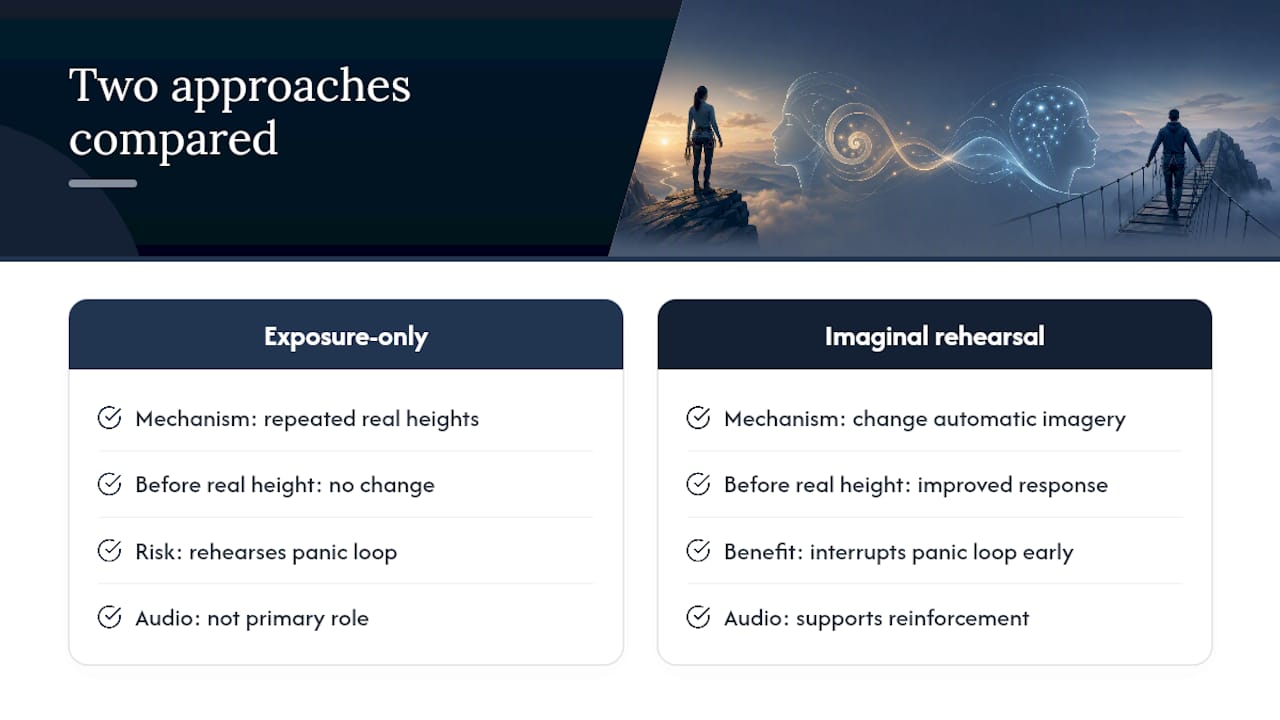
That's the piece conventional advice skips. Standing on a balcony repeatedly without addressing the automatic fall imagery just rehearses the panic loop. It doesn't necessarily interrupt it.
What I'd prioritize first, based on what the evidence actually shows: get the automatic imagery under control before you stack up exposure hours. That means a session or two focused specifically on the imaginal work, not weeks of forcing yourself onto ladders and hoping it fades. Audio can support that process, but it works best as reinforcement, not a replacement for someone who can screen you properly and adjust the approach when something isn't landing. The number needed to treat from that trial, around six, tells you this isn't magic for everyone. It's a real, moderate-sized tool worth trying before you commit to months of harder exposure work.
— Kirk
Ready to Book a Session for Fear of Heights?
Online clinical hypnotherapy is available through Zoom, built around the same session structure covered above: screening, guided imaginal exposure, anchor work, and real-world homework between sessions. If you've read this far because a balcony, a bridge, or a flight is something you actively avoid, a live session with a Certified Clinical Hypnotherapist gets you further than a recording alone, especially if your fear includes real panic symptoms.
A free consultation covers your specific triggers, prior attempts at treatment, and what a realistic session plan looks like for you, no guesswork, no generic script. Sessions are booked individually or as part of a multi-session package depending on how much support you need. You can review the online hypnotherapy for anxiety and phobias page or go straight to scheduling a consultation to get a session on the calendar this week.
This article is general information, not a substitute for advice from a qualified doctor. Consult a qualified healthcare professional about your own circumstances before acting on anything here.
Sources
- A brief treatment for fear of heights: A randomized controlled trial of a novel imaginal intervention (Arroll et al., 2017)
- A brief treatment for fear of heights: A randomized controlled trial of a novel imaginal intervention (Journal site)
- Clinical trial: VR-supported trance induction and height exposure (NCT06618456)
FAQ
Can You Be Hypnotized for Fear of Heights?
Yes. Most people can enter a hypnotic state useful for imaginal exposure work, and the 2017 randomized controlled trial showed measurable improvement using this exact approach. Susceptibility varies by person, which is worth discussing during a consultation.
What Is the Best Way to Get Over a Fear of Heights?
A combined approach works best for most people: hypnotherapy or hypnosis audio to interrupt the automatic fall imagery, paired with gradual, repeated real-world exposure to actual heights. Skipping straight to exposure without addressing the mental imagery often just rehearses the panic response instead of resolving it.
What Causes Extreme Fear of Heights?
Acrophobia is usually maintained by a fast loop where the brain generates a catastrophic image, often of falling, and the body responds with a full fight-or-flight reaction before conscious thought catches up. Past falls, a frightening childhood experience, or no clear cause at all can all trigger this same loop.
What Is Height Vertigo?
Height vertigo is the dizziness or unsteady sensation some people feel when looking down from an elevated point, distinct from clinical vertigo caused by inner-ear issues. It's often driven by visual and balance signals conflicting at height, and it frequently overlaps with the anxiety response acrophobia produces.