
Ericksonian hypnosis is a naturalistic, conversational form of hypnotherapy that uses indirect suggestion, metaphor, and a principle called utilization to work with the subconscious mind rather than issue commands at it. Developed by psychiatrist Milton H. Erickson, later codified into the Milton Model by Richard Bandler and John Grinder, and now taught through the Milton H. Erickson Foundation, this approach is particularly well-suited to adults dealing with anxiety, panic, phobias, and fear-based thinking. Unlike scripted hypnosis, it adapts to each person's language, behavior, and nervous system state. The clinical goal is reduced symptom reactivity and improved coping, often noticeable within the first few sessions.
Key Takeaways
Ericksonian hypnosis works by using indirect language, metaphor, and utilization to engage the subconscious mind directly, bypassing the conscious resistance that keeps anxiety patterns locked in place.
| Point | Details |
|---|---|
| Definition and origin | A naturalistic, conversational hypnotherapy developed by Milton H. Erickson, codified in the Milton Model, and taught through the Milton H. Erickson Foundation. |
| Core mechanism | Indirect suggestion and pacing reduce fight-or-flight arousal by bypassing conscious resistance and engaging the subconscious. |
| Evidence base | A meta-analysis found Ericksonian hypnotherapy produced significant effects across diverse outcomes, though the evidence base is still growing. |
| Best clinical fit | Adults with anxiety, panic, phobias, or fear-based thinking, particularly those who have not responded to directive approaches. |
| Hypnotictransformations | Kirk Hoffman CCHt offers online Ericksonian-style hypnotherapy for anxiety via Zoom, with sessions tailored to each client's subconscious patterns. |
Table of Contents
- What is Ericksonian hypnosis and where did it come from?
- What are the core principles behind Ericksonian practice?
- What are the main Ericksonian techniques, and how do they work?
- How does Ericksonian hypnosis differ from traditional hypnosis?
- How does Ericksonian hypnosis appear to work neurologically?
- What conditions does Ericksonian hypnotherapy treat, and what does the research show?
- How do you find qualified Ericksonian training and practitioners in the United States?
- What actually happens in an Ericksonian hypnotherapy session?
- Why indirect hypnosis works when direct approaches don't
- Hypnotictransformations: online Ericksonian-style hypnotherapy for anxiety
- Useful sources and further reading
What is Ericksonian hypnosis and where did it come from?
The story starts with a man who had every reason to distrust rigid systems. Milton H. Erickson contracted polio twice, first as a teenager and again in his forties, and spent long periods observing his own body's responses and the subtle ways people communicate without words. That experience shaped a clinical philosophy unlike anything his contemporaries were practicing.
Here are the major milestones in the development of the approach:
- 1920s–1930s: — Erickson begins experimenting with hypnosis as a medical student and early psychiatrist, rejecting the authoritarian "sleep and obey" model dominant at the time. He notices that trance arises naturally in conversation and that resistance can be used rather than overcome.
The shift that matters clinically is this: older directive hypnosis assumed the therapist knew best and the client needed to comply. Erickson's model assumes the client already has the resources needed, and the therapist's job is to help access them. As Dr. Michael Yapko describes it, Erickson moved the field away from mechanical scripts toward skilled, relational clinical practice, where the therapist's responsiveness to the individual is the primary therapeutic tool.
What are the core principles behind Ericksonian practice?
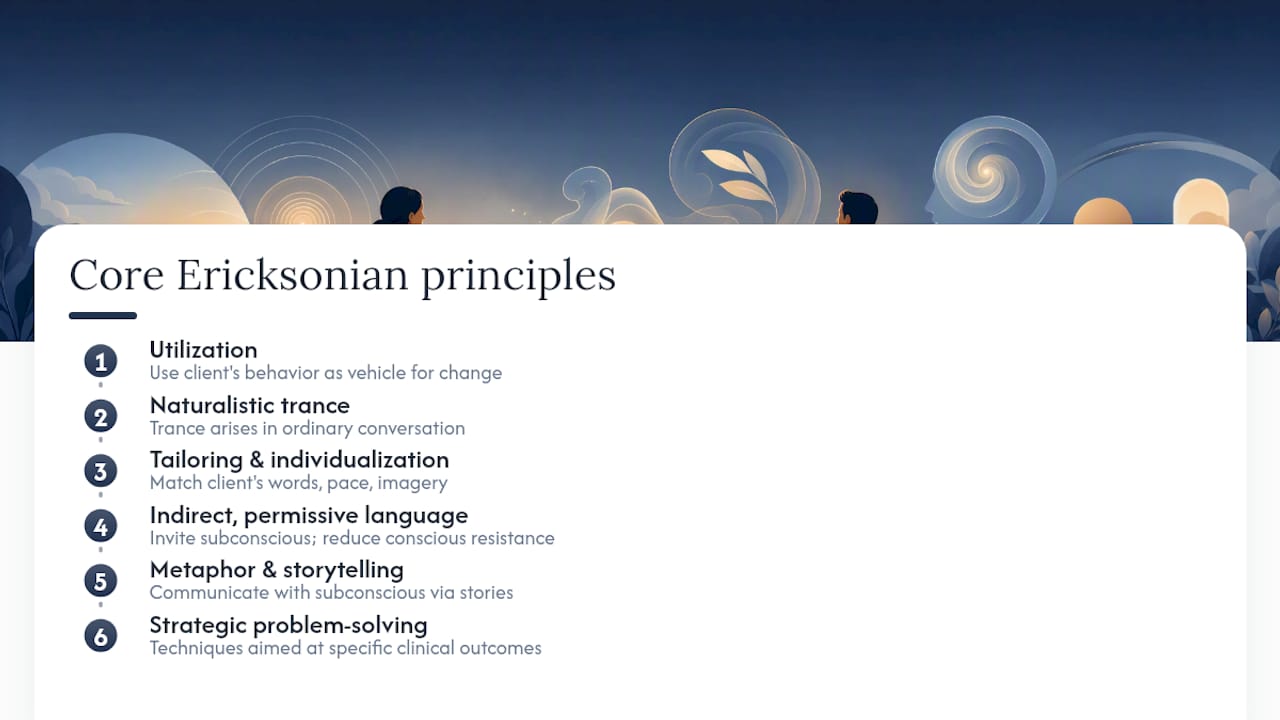
Six principles define how a trained Ericksonian clinician actually works. Understanding them helps you evaluate whether a practitioner is genuinely using this approach or just calling a scripted session "Ericksonian."
Utilization is the foundation. Rather than asking a client to relax before they are ready, the clinician uses whatever the client brings, including anxiety, fidgeting, skepticism, or even resistance, as the vehicle for change. A client who says "I can't stop my mind from racing" might hear: "And that active mind of yours can keep moving, noticing things, while another part of you begins to settle."
Naturalistic trance means trance is not a special state that requires a formal ceremony to enter. It arises in ordinary conversation through focused attention, absorbed listening, or vivid mental imagery. Erickson demonstrated this repeatedly: a client could enter a functional trance while discussing their week, with no formal induction at all.
Tailoring and individualization means no two sessions look the same. The clinician matches the client's vocabulary, pacing, and representational style. Someone who describes anxiety as a "tight fist in my chest" will hear that image reflected back and worked with, not replaced by a generic relaxation script.
Indirect and permissive language reduces the conscious mind's tendency to argue or dismiss. Instead of "You will feel calm," the clinician might say, "You might begin to notice, at some point, a kind of settling." The difference is not just stylistic. Indirect language bypasses conscious resistance and invites the subconscious to respond on its own terms.
Metaphor and storytelling allow the clinician to communicate with the subconscious in its native language. A story about a tree bending in a storm without breaking carries a message about resilience that a direct instruction never could.
Strategic problem solving means the clinician is always working toward a specific clinical outcome, not just inducing relaxation. Each technique serves a therapeutic goal tied to the client's presenting problem.
Pro Tip: When evaluating a clinician, listen to how they respond when you express doubt or resistance. An Ericksonian practitioner will incorporate your skepticism into the session rather than trying to talk you out of it. That's utilization in real time.
What are the main Ericksonian techniques, and how do they work?
The techniques below are not tricks. Each one serves a specific function in helping the nervous system shift out of a threat-response pattern. Here is how they sound in practice, particularly with anxiety clients.
- Conversational (Ericksonian) induction: — Trance begins within ordinary dialogue, with no announcement. The clinician paces the client's breathing, matches their speech rhythm, and gradually slows both. A client describing a panic attack might find themselves speaking more slowly, breathing more deeply, before they realize anything has changed. No scripts, no swinging watches — just calibrated conversation.
"Ericksonian inductions do not announce themselves. Practitioners calibrate to physiological cues — the swallowing reflex, limb stillness, changes in blink rate — and use silence as a deepening tool rather than filling every moment with words." — Clinical description from ericks.org
Ethical use of these techniques requires explicit informed consent before the session, ongoing calibration to the client's responses, and the ability to stop or shift direction if the client shows signs of distress. Pacing is not manipulation; it is attunement.
How does Ericksonian hypnosis differ from traditional hypnosis?
If you have seen stage hypnosis or read about older clinical hypnosis, you may picture a therapist counting backward while a client stares at a pendulum, then issuing direct commands. That is directive hypnosis. Ericksonian work looks and feels quite different.
| Feature | Traditional / Directive Hypnosis | Ericksonian Hypnosis |
|---|---|---|
| Language style | Direct commands ("You will relax") | Indirect, permissive ("You might notice...") |
| Induction method | Formal, scripted, announced | Conversational, naturalistic, unannounced |
| Client role | Passive recipient of suggestions | Active collaborator; resources come from within |
| Resistance | Treated as a problem to overcome | Utilized as material for intervention |
| Session structure | Standardized scripts per condition | Individualized to each client's language and behavior |
| Therapist stance | Authority figure directing the client | Relational guide following the client's lead |
| Best fit | Motivated, compliant clients; simple habit change | Complex anxiety, resistant clients, trauma-adjacent work |
For anxiety specifically, the indirect approach tends to work better with clients whose nervous systems are already in a hypervigilant state. A direct command to "relax now" can actually increase arousal in someone whose fight-or-flight response is activated, because the command feels like pressure. Indirect language sidesteps that reaction entirely.
Questions to ask a therapist to confirm which approach they use:
- "Do you use scripted inductions, or do you adapt to what I bring to the session?"
- "How do you work with resistance or skepticism?"
- "What happens if I don't feel like I'm going into trance?"
A clinician who answers these with flexibility and curiosity is likely working in an Ericksonian or naturalistic style. One who describes a fixed protocol is probably using directive methods.
How does Ericksonian hypnosis appear to work neurologically?
The mechanisms are not fully mapped, but several converging lines of research point to what is happening in the brain and nervous system during an Ericksonian session.
Attentional narrowing and redirection is the most consistent finding. Hypnotic states involve a shift in how the brain allocates attention, reducing activity in the default mode network (associated with rumination and self-referential worry) and increasing focused, absorbed processing. For anxiety clients, this alone can interrupt the loop of anticipatory fear.
Modulation of autonomic arousal follows from pacing and leading. When a clinician matches a client's breathing and then gradually slows it, the parasympathetic nervous system responds. Heart rate variability increases, cortisol production decreases, and the fight-or-flight response begins to downregulate. This is not metaphor; it is measurable physiology.
Bypassing conscious resistance through indirect language works because the prefrontal cortex, which handles critical evaluation and argument, is less engaged during absorbed, trance-like states. Presuppositions and embedded commands reach the subconscious before the analytical mind can reject them. The Milton Model's language patterns are specifically designed to exploit this window.
Memory reconsolidation is a more recent area of interest. When a fearful memory is activated in a calm, resourced state, it becomes temporarily labile and can be updated. Ericksonian techniques that pair the activation of a feared memory with a state of safety may facilitate this process, though the research here is still developing.
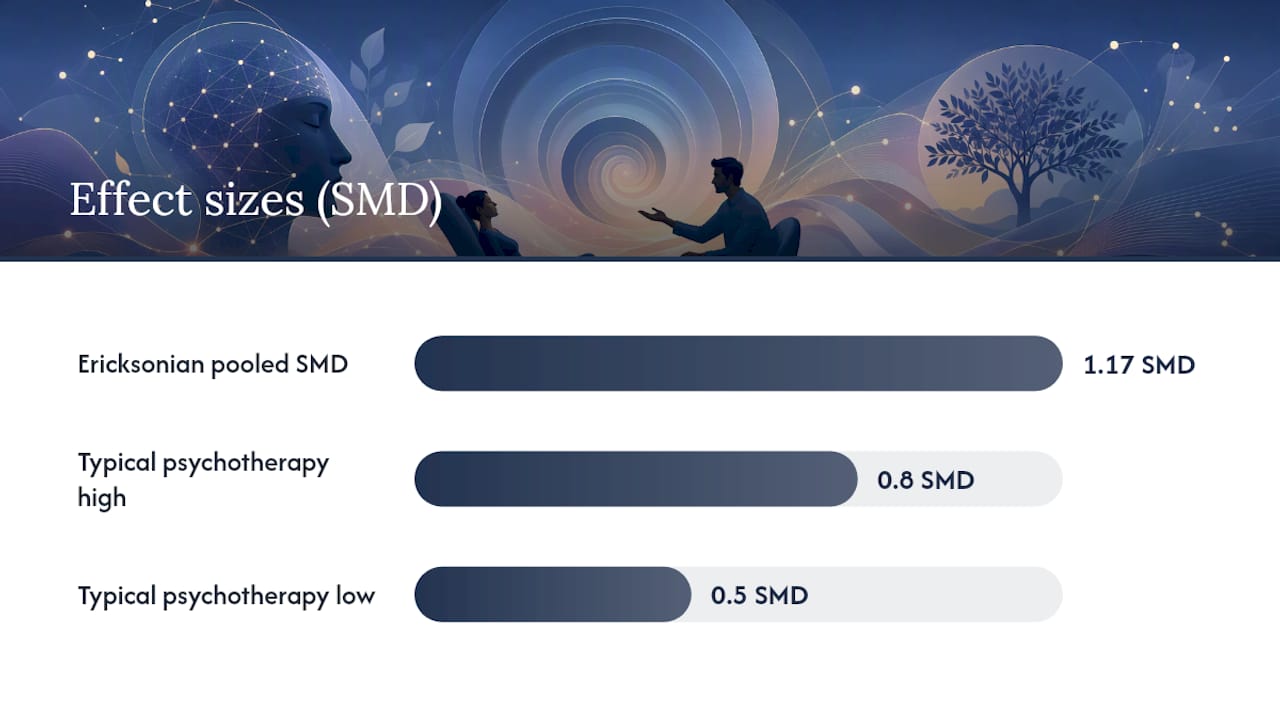
The evidence base is growing but not yet definitive. A systematic review and meta-analysis of randomized controlled trials found a pooled standardized mean difference of 1.17 (95% CI: 0.70–1.64) across eight eligible RCTs involving 676 participants, suggesting large effects across diverse outcomes. The same review noted non-inferiority to some active treatments. The authors also flagged heterogeneity across trials and called for more targeted mechanism studies.
Statistic to know: A pooled SMD of 1.17 is considered a large effect in clinical psychology. For context, many well-established psychotherapy interventions produce SMDs in the 0.5–0.8 range. The caveat is that eight trials with 676 participants is a relatively small evidence base, and the conditions studied varied widely.
What conditions does Ericksonian hypnotherapy treat, and what does the research show?
The NCBI clinical overview of hypnosis and hypnotherapy situates hypnotic methods within both medical and psychological practice, noting established uses alongside areas where higher-quality trials are still needed. Here is how the evidence maps onto specific conditions relevant to this audience.
| Condition | Evidence Direction | Notes |
|---|---|---|
| Anxiety and panic | Positive, moderate-to-large effects | Multiple RCTs; indirect suggestion and pacing well-suited to hypervigilant presentations |
| Specific phobias | Positive, limited trials | Metaphor and desensitization protocols show promise; fewer RCTs than CBT |
| Acute procedural pain | Strong positive evidence | One of the most replicated areas in clinical hypnosis broadly |
| Smoking cessation | Positive, mixed quality | Habit-change protocols benefit from utilization and embedded commands |
| IBS and functional GI | Positive, reasonable evidence base | Gut-directed hypnotherapy protocols overlap with Ericksonian methods |
| Chronic pain | Positive, growing evidence | Attentional redirection and reframing mechanisms well-supported |
| Disordered eating | Emerging, limited trials | Body-image metaphors and subconscious reframing used clinically |
For readers considering hypnotherapy for anxiety and depression, the evidence is most consistent for anxiety-spectrum presentations. Panic disorder, generalized anxiety, and specific phobias all have clinical case support and some RCT evidence.
Contraindications and when to refer out:
- Active psychosis or psychotic features: hypnotic states can blur reality testing further; refer to psychiatry first.
- Unmanaged severe dissociation: trance-like states may deepen dissociative episodes in vulnerable clients; a trauma-specialist assessment is needed before proceeding.
- Uncontrolled medical emergencies: hypnosis is adjunctive, not primary care. A client with undiagnosed chest pain needs a cardiologist, not a hypnotherapist.
- Severe personality disorders with poor reality testing: proceed only with psychiatric consultation and clear clinical framing.
This article provides general educational information, not medical or clinical advice. Confirm your specific situation with a licensed healthcare provider before beginning any hypnotherapy program.
How do you find qualified Ericksonian training and practitioners in the United States?
Training quality varies enormously in the hypnotherapy field. Here is what to look for.
Reputable training bodies and resources:
- The Milton H. Erickson Foundation offers workshops, congresses, and archived demonstrations. It is the primary institutional resource for Ericksonian training in the United States and internationally.
- The American Society of Clinical Hypnosis (ASCH) and the Society for Clinical and Experimental Hypnosis (SCEH) both offer credentialing for licensed mental health professionals and physicians.
- University-affiliated continuing education programs in clinical psychology and psychiatry increasingly include hypnotherapy modules.
Practitioner checklist — what to verify before booking:
- State licensure as a mental health professional (LCSW, LPC, psychologist, psychiatrist, or equivalent) OR a Certified Clinical Hypnotherapist (CCHt) credential from a recognized body
- Documented training in Ericksonian or clinical hypnosis (not just a weekend certification)
- Supervised clinical hours with anxiety or trauma presentations specifically
- Familiarity with telehealth delivery if you are seeking online sessions
- Willingness to discuss contraindications, session structure, and expected outcomes at intake
Questions to ask at a first consultation:
- "What training do you have specifically in Ericksonian or indirect hypnosis?"
- "How do you structure a first session for someone with anxiety?"
- "What happens if I feel uncomfortable or want to stop?"
- "How many sessions do most of your anxiety clients need before noticing a shift?"
- "Do you use scripted protocols or adapt to each client?"
A practitioner who cannot answer these questions clearly, or who promises specific outcomes in a fixed number of sessions without an intake assessment, is a red flag.
What actually happens in an Ericksonian hypnotherapy session?
Most people expect a formal ceremony. What they get is closer to a focused conversation that gradually becomes something else.
Intake and goal setting (15–20 minutes): The clinician asks about the presenting problem, its history, and what the client wants to be different. This is not just information gathering. A skilled Ericksonian clinician is already listening for the client's language patterns, metaphors, and representational style. The words a client uses to describe their anxiety become the raw material for the session.
Calibration and pacing (5–10 minutes): The clinician begins matching the client's breathing, speech rhythm, and posture. This is the pacing phase. The client often does not notice it happening. Physiological signs of trance, including slowed swallowing, reduced blink rate, and limb stillness, begin to appear without any formal induction.
Conversational induction and intervention (20–30 minutes): The transition into deeper trance is gradual and often unmarked. The clinician introduces metaphors, embedded suggestions, and utilization techniques tailored to the client's specific anxiety presentation. A client with health anxiety might hear a story about a doctor who learned to trust the body's own signals. A client with social phobia might receive suggestions about the natural ease of being absorbed in something interesting.
Debrief and between-session practice (10 minutes): The clinician brings the client back to full alertness, checks in about the experience, and may assign a simple between-session practice, such as a self-hypnosis exercise or a specific attention-shifting technique. Self-hypnosis for success between sessions can extend the effects of in-session work.
Realistic outcomes for anxiety clients: Most clients report reduced physiological tension within the first session. Clearer access to coping options, reduced reactivity to triggers, and partial symptom reduction are common after two to four sessions. Measurable change in anxiety severity typically requires a course of six to twelve sessions, depending on the complexity of the presentation.
When to consider adjunctive care: if anxiety is accompanied by significant depression, trauma history, or medical factors, a psychiatric evaluation or CBT referral alongside hypnotherapy is often the most effective approach.
Why indirect hypnosis works when direct approaches don't
Most anxiety clients have already tried the direct approach. They have been told to breathe, to think positively, to challenge their thoughts. They know, intellectually, that the panic is not a real threat. The problem is that the subconscious mind does not respond to intellectual arguments. It responds to experience, imagery, and the felt sense of safety.
That is what makes Ericksonian work different from most anxiety interventions. The clinician is not trying to convince the anxious mind of anything. The clinician is creating conditions in which the nervous system can experience something other than threat, often without the client even realizing the shift is happening.
The confusion technique, for example, is not a gimmick. It works because hypervigilant clients are running a constant threat-detection loop. A moment of genuine cognitive confusion interrupts that loop. In that gap, a suggestion for calm can land somewhere the analytical mind would normally block it.
What I find most clinically significant about Erickson's legacy is not any single technique. It is the underlying assumption: that the client is not broken and does not need to be fixed from the outside. The subconscious already contains the resources. The clinician's job is to help the client access what is already there. That framing changes everything about how a session feels, and it is why clients who have felt dismissed or pathologized by other approaches often respond quickly to this one.
Hypnotictransformations: online Ericksonian-style hypnotherapy for anxiety
If you are dealing with anxiety that has not shifted despite talk therapy, medication, or self-help strategies, the missing piece is often the subconscious. Cognitive approaches work at the level of thought. Ericksonian hypnotherapy works at the level of the nervous system's learned responses, the patterns that run automatically before conscious thought even begins.
Hypnotictransformations offers online hypnotherapy for anxiety via Zoom, led by Kirk Hoffman, Certified Clinical Hypnotherapist. Sessions use conversational induction, indirect suggestion, and utilization techniques tailored to your specific anxiety presentation, whether that is panic, phobias, health anxiety, or chronic fear-based thinking. Services also include smoking cessation and weight management hypnotherapy. A free consultation is available to discuss your situation, confirm fit, and answer questions about the approach before you commit to a session. All sessions are conducted with full informed consent and clear ethical boundaries. To see the full range of services and book a session, visit the Hypnotictransformations services page.
Useful sources and further reading
-
Ericksonian Hypnotherapy: A Systematic Review and Meta-Analysis of RCTs — The most current quantitative summary of Ericksonian hypnotherapy's clinical effects. Reports a pooled SMD of 1.17 across eight RCTs (N = 676) and discusses non-inferiority to some active treatments. Essential reading for anyone evaluating the evidence base.
-
Milton Hyland Erickson, 1901–1980 | American Journal of Psychiatry — Authoritative historical and definitional summary of Erickson's approach. Covers his nondirective, naturalistic style and the utilization principle. Good starting point for understanding the clinical philosophy.
-
Milton Erickson Hypnotic Language Patterns | ericks.org — Explains the Milton Model language patterns (embedded commands, presuppositions, conversational postulates) and their therapeutic functions. Useful for understanding how indirect suggestion works technically.
-
The Milton H. Erickson Foundation — The primary institutional resource for Ericksonian training in the United States. Offers workshops, international congresses, and an archive of Erickson's clinical demonstrations.
-
What Is Ericksonian Hypnosis? The Conversational Approach | ericks.org — Accessible clinical overview explaining how Ericksonian hypnosis uses utilization, metaphor, and conversational interventions, and why sessions often look like ordinary conversation.
-
Maverick Erickson | Michael Yapko (PDF) — Expert practitioner perspective from Dr. Michael Yapko on Erickson's shift away from scripted, mechanical hypnosis toward relational clinical practice. Published in the International Journal of Clinical and Experimental Hypnosis.
-
Hypnosis and Hypnotherapy Overview | NCBI Bookshelf — Clinical overview situating hypnotic methods within medical and psychological practice. Covers established uses, research gaps, and the integration of hypnosis with psychotherapy.