
Clinical hypnotherapy is a therapeutic technique in which a trained clinician guides a client into a state of focused attention, reduced peripheral awareness, and heightened responsiveness to suggestion, then uses that state to treat a specific psychological or physical concern. That's the American Psychological Association's working definition, and it matters because it separates real clinical practice from stage tricks and vague "mind power" claims you've probably run into online.
Clinicians use it most often for anxiety, chronic pain, phobias, and behavior change like smoking cessation, and it's almost always delivered by a licensed provider rather than a self-help app. It's not a fringe treatment. The Merck Manual lists it as an evidence-based complementary approach, Cleveland Clinic describes it in patient guidance, and the VA covers it as part of whole health care when clinically appropriate.
If you're dealing with panic attacks, a specific phobia, or anxiety that won't quiet down no matter how much you've tried to think your way out of it, here's what you need to know before booking a session:
- Clinical hypnotherapy targets the nervous system's threat response, not just conscious thoughts about the fear.
- It's clinician-led, goal-specific, and typically part of a broader treatment plan, not a standalone cure-all.
- Sessions generally run for a standard duration and follow a repeatable structure: induction, deepening, suggestion, and emergence.
Key Takeaways
Clinical hypnotherapy is a clinician-led technique using focused attention and suggestion to treat anxiety, pain, and behavior patterns, and it works best alongside, not instead of, other care.
| Point | Details |
|---|---|
| Definition anchors on attention | The APA defines it as focused attention, reduced peripheral awareness, and heightened responsiveness to suggestion. |
| It's clinician-led, not stage hypnosis | Clinical sessions are private, goal-directed, and delivered by trained, licensed practitioners. |
| Sessions follow four stages | Induction, deepening, therapeutic suggestion, and emergence typically fill a standard length appointment. |
| Evidence varies by condition | Anxiety, phobias, and IBS have stronger support; smoking cessation and weight management show more mixed results. |
| Credentials matter most | Look for a licensed mental health background plus specific hypnotherapy certification before booking. |
Table of Contents
- Clinical Hypnotherapy Meaning vs. Stage Hypnosis and General Hypnosis
- How Does Clinical Hypnotherapy Work?
- What Conditions Does Clinical Hypnotherapy Treat?
- What Happens During a Clinical Hypnotherapy Session?
- Is Clinical Hypnotherapy Safe? Risks and Limits
- How to Find a Qualified Clinical Hypnotherapist
- How Hypnotic Transformations Applies This to Anxiety and Fear
- Ready to Address Anxiety at the Source?
- What the Research Actually Tells Us About This Field
- Frequently Asked Questions
- Sources
Clinical Hypnotherapy Meaning vs. Stage Hypnosis and General Hypnosis
Here's where most people get confused. They've seen a hypnotist on stage make someone cluck like a chicken, and they assume that's what a hypnotherapy session looks like. It isn't.
Stage hypnosis is entertainment. The performer selects highly suggestible volunteers from a crowd, uses social pressure and showmanship, and aims for a laugh. Clinical hypnotherapy is the opposite setup: private, goal-directed, and delivered by someone trained to treat anxiety, pain, or a behavioral pattern you actually want to change. The word "hypnosis" on its own gets used loosely for both, which is part of why the clinical version needs its own name.
The ASCH, a professional society for clinicians who use hypnosis, frames it plainly: this is a focused, guided technique delivered by licensed and trained practitioners, not a party trick.
A few myths worth killing outright:
- "You lose control of yourself." You don't. You stay aware and can stop at any point. It's closer to deep absorption, like getting lost in a good book, than to sleep or blackout.
- "The hypnotherapist can make you do anything." No. Suggestion works with your own goals and values, not against them. Your brain still filters out suggestions that conflict with your sense of self.
- "It erases memories or rewrites your past." It doesn't erase anything. It can change how a memory or trigger gets processed emotionally, but the actual memory stays intact.
Pro Tip: If a practitioner promises they can "erase" your fear permanently in one session or claims total control over your mind, that's a red flag, not a selling point. Real clinical work talks about your nervous system and your response patterns, not magic.
How Does Clinical Hypnotherapy Work?
The honest, current answer from researchers is that we don't have a single settled mechanism. What the peer-reviewed literature agrees on is that hypnosis involves a shift in attention. Your focus narrows, awareness of your surroundings fades a bit, and your brain becomes more open to specific, targeted suggestions. That narrowed state is what a clinician uses to work directly with the patterns driving anxiety or fear.
A typical clinical session moves through four stages:
- Induction. The clinician guides you into a relaxed, focused state, usually through breathing cues, progressive relaxation, or a fixed point of attention. This takes a few minutes.
- Deepening. Suggestions or imagery deepen the relaxed focus, similar to walking further into a quiet room instead of standing at the doorway.
- Therapeutic suggestion. This is the working phase. The clinician offers specific, targeted suggestions tied to your goal, whether that's calming a panic response, reframing a phobic trigger, or reinforcing a new habit.
- Emergence. You're guided back to full alert awareness, gradually, the same way you'd wake up gently rather than get jolted by an alarm.
Anxiety and fear responses live largely in the nervous system's fight-or-flight circuitry, not just in conscious thought. That's why simply "deciding" to stop being afraid of flying or crowds rarely works. Clinical hypnotherapy works with that circuitry directly. The Merck Manual notes it can help accelerate changes in habitual fight-or-flight reactions by giving clients a way to rehearse a calmer response while the nervous system is in a receptive, focused state.
A key clinical distinction: hypnosis is not passive relaxation. It's active and directive. A 2024 APA Monitor piece on the science of hypnosis describes clinicians using the hypnotic state to actively "edit" how a client interprets a memory or a trigger in real time, rather than just calming the body down and hoping the fear fades on its own.

Many clinicians also teach self-hypnosis as homework between sessions, a short daily practice that reinforces the same focused, calming state you learn in the office. It's not a replacement for clinical sessions, but it extends the work.
What Conditions Does Clinical Hypnotherapy Treat?
The evidence base isn't uniform across every use case, and a responsible clinician will tell you that upfront instead of promising a fix for everything.
- Anxiety disorders and panic: Moderate to solid evidence, particularly when combined with cognitive behavioral techniques. This is one of the more studied applications.
- Specific phobias: Moderate evidence; hypnosis is often used to desensitize a specific trigger, like flying or needles, alongside exposure-based approaches.
- Chronic pain: Reasonably strong evidence, especially for pain that has a strong stress or nervous system component.
- Irritable bowel syndrome (IBS): One of the better-studied applications, with a recognized track record in gut-brain axis conditions.
- Smoking cessation: Mixed evidence; effectiveness varies a lot depending on the person and how many sessions are used.
- Weight management: Limited but promising evidence, generally most useful when paired with behavioral and nutritional support.
- Cancer-related distress: Growing evidence for reducing anxiety and improving coping around treatment and procedures.
The Merck Manual is explicit on a point worth repeating: hypnotherapy is generally used as a complement to psychotherapy or medical treatment, not a replacement for either. If you're managing a phobia alongside a psychiatrist or working through IBS with a gastroenterologist, hypnotherapy sits alongside that care, not instead of it. If cancer-related anxiety is part of your picture, a clinical breakdown of what the evidence shows walks through how that specific application works.
What Happens During a Clinical Hypnotherapy Session?
Your first appointment usually starts with an intake conversation, not hypnosis. The clinician asks about your specific fear or anxiety pattern, when it started, what triggers it, and what you've already tried. This groundwork shapes every suggestion used later.
- Intake (session one, often 20 to 30 minutes of the appointment): Goals get defined. If you're dealing with panic attacks on flights, for example, the clinician needs to know exactly when the panic starts, what physical sensations show up first, and what you've tried before.
- Induction and deepening (5 to 15 minutes): You settle into the focused, relaxed state described earlier.
- Working phase (20 to 30 minutes): Suggestions target your specific pattern. For fear-based anxiety, this often means rehearsing a calmer physical and mental response to the exact trigger you named in intake.
- Emergence and debrief (5 to 10 minutes): You come back to full alertness and talk through what you noticed.
Most clients remember the session; this isn't sleep, and you're not "out." Common sensations include heaviness in the limbs, a slowed sense of time, and a noticeable drop in muscle tension. Full appointments generally last a standard length of time, and most clinicians recommend multiple sessions rather than a single visit, especially for anxiety patterns that have been reinforced over years.
Homework often includes a short self-hypnosis recording or script to practice daily, reinforcing the calmer nervous system response between visits. Some clinicians also fold in cognitive behavioral techniques or guided imagery within the same session, particularly for fear-based thinking that has a strong "what if" mental loop attached to it.
Is Clinical Hypnotherapy Safe? Risks and Limits
For most people, clinical hypnotherapy carries a low risk profile. Side effects, when they happen, tend to be mild: temporary drowsiness, a headache, or lightheadedness right after a session. Uncommon reactions include unexpected emotional responses if a session touches on a sensitive memory.
That said, it's not a fit for everyone, and a competent clinician screens for this before starting:
- Active, unstable psychosis is a contraindication; hypnosis is not appropriate as a standalone approach for someone in acute psychotic episodes.
- Severe dissociative disorders need integrated care with a licensed mental health provider, not hypnotherapy alone.
- A history of trauma that hasn't been stabilized needs careful, coordinated treatment, since hypnotic focus can sometimes surface distressing material without the right support in place.
Watch for these red flags in a practitioner: promises of a guaranteed cure in one session, refusal to explain their training or credentials, discouraging you from continuing other medical or psychiatric care, or vague "energy healing" language substituted for actual clinical terms like nervous system regulation or cognitive reframing.
Pro Tip: Ask any prospective clinician directly what happens if hypnotherapy surfaces a difficult memory or emotion mid-session. A well-trained provider has a clear, specific answer. A vague one is a warning sign.
How to Find a Qualified Clinical Hypnotherapist
Credentials matter here more than almost anywhere else in complementary medicine, because "hypnotherapist" isn't a tightly regulated title everywhere. The strongest pathway is a licensed mental health professional (psychologist, counselor, clinical social worker) who has completed additional hypnotherapy certification training, often aligned with guidance from the APA's Division 30 on psychological hypnosis.
Before booking, ask a prospective clinician:
- What is your base license (psychology, counseling, social work, nursing) and is it active?
- What specific hypnotherapy certification training have you completed, and through which program?
- How much experience do you have treating anxiety, panic, or phobias specifically?
- How do you coordinate with a client's existing therapist or physician, if they have one?
- What does a typical treatment plan and session count look like for my specific concern?
- What is your cancellation and rescheduling policy?
- How is my session information kept private, especially for telehealth sessions?
- What happens if I don't respond to hypnotic suggestion the way most clients do?
- A qualified clinician answers all of these clearly and without defensiveness.
- Professional disclosure statements, license numbers, and clear scope-of-practice language are standard, not extra credit.
How Hypnotic Transformations Applies This to Anxiety and Fear
At Hypnotic Transformations, sessions focus specifically on the subconscious patterns driving a fight-or-flight reaction, whether that shows up as panic attacks, a specific phobia, or the kind of anxious anticipation that keeps someone awake at 2 a.m. running through worst-case scenarios. Kirk Hoffman, a Certified Clinical Hypnotherapist, builds each session plan around the client's specific trigger pattern rather than a generic anxiety script.
A typical intake identifies the exact moment fear spikes (a specific thought, sensation, or situation), then session work rehearses a new response to that exact trigger while the nervous system is in a focused, receptive state. Self-hypnosis practice between sessions reinforces the change, and progress gets tracked against the client's own stated goals rather than a one-size-fits-all benchmark.
Anxiety rarely responds well to being argued with. It responds to the nervous system learning, through repetition, that the old alarm signal is no longer accurate. That's the work.
Readers wanting more detail on specific applications can look at resources on hypnosis for smoking cessation tied to anxiety-driven habits or evidence-based approaches to generalized anxiety.
Ready to Address Anxiety at the Source?
If panic, phobias, or fear-based thinking have been running the show for months or years, talk therapy and willpower alone often aren't enough, because the reaction is wired into the nervous system, not just sitting in conscious thought. Clinical hypnotherapy gives that system a different, calmer pattern to practice.
Hypnotic Transformations offers online sessions via Zoom specifically built around anxiety and fear relief, led by Certified Clinical Hypnotherapist Kirk Hoffman. Sessions are structured around your specific trigger, not a generic script, and a free consultation is the way to find out whether it fits your situation before you commit to a package. For anyone whose anxiety runs alongside another health condition, it's also worth reviewing coordinated care options like the information on medical cannabis for trauma-related symptoms as a point of comparison for how integrative approaches get structured.
What the Research Actually Tells Us About This Field
The gap I keep noticing is between how hypnotherapy gets marketed and what the actual research supports. Marketing language promises transformation in one session. The research supports something more modest and, honestly, more believable: a focused technique that helps rehearse a calmer nervous system response, most effective when paired with other care rather than used alone.
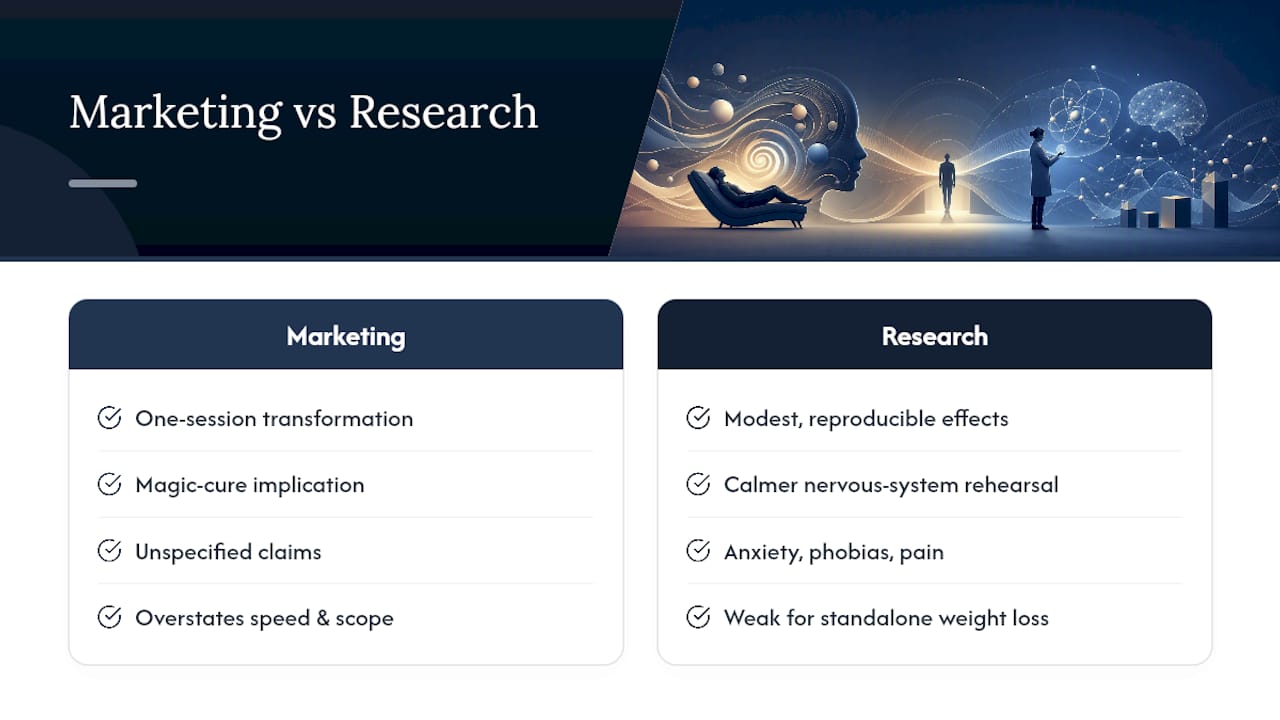
The conventional advice out there treats hypnotherapy as either magic or nonsense, with nothing in between. Both are wrong. The APA and Merck Manual framing is closer to reality: a legitimate clinical tool with real but bounded evidence, strongest for anxiety, phobias, and pain, weaker for things like weight loss on its own.
If you're considering this for fear-based thinking, prioritize the clinician's credentials and their willingness to coordinate with your existing care over any promise of speed. A provider who asks about your specific trigger pattern before making claims is doing this right.
Frequently Asked Questions
What is the clinical hypnotherapy definition in simple terms? It's a therapeutic technique where a trained clinician guides you into a state of focused attention and heightened responsiveness to suggestion, then uses that state to address anxiety, pain, or a specific behavior pattern.
How is clinical hypnotherapy different from meditation or mindfulness? Meditation is generally passive, aimed at accepting thoughts as they arise. Clinical hypnotherapy is active and directive, with a clinician steering specific suggestions toward a defined therapeutic goal.
Does hypnotherapy work for panic attacks and phobias? There's moderate evidence supporting its use for anxiety disorders and specific phobias, particularly when combined with cognitive behavioral approaches rather than used alone.
How many sessions does clinical hypnotherapy usually take? It varies by condition and person, but most clinicians recommend a series of sessions rather than a single visit, especially for anxiety patterns built over years.
Can anyone be hypnotized? Most people can enter a hypnotic state to some degree, though responsiveness to suggestion varies. A qualified clinician adjusts their approach based on how a client responds.
Is clinical hypnotherapy covered by insurance? Coverage varies by provider and plan. Some systems, including the VA, include clinical hypnosis among covered complementary approaches when clinically indicated.
This article is general information, not a substitute for advice from a qualified doctor. Consult a qualified healthcare professional about your own circumstances before acting on anything here.
Sources
- APA: Hypnosis
- Merck Manual: Hypnotherapy
- What is hypnosis and how might it work? - PMC
- Cleveland Clinic: Hypnosis
- VA Whole Health: Clinical Hypnosis