
Hypnosis can measurably reduce burnout symptoms, but not the way most people picture it. The strongest evidence comes from a 1,850-person survey of healthcare providers who completed a year of medical hypnosis training and showed drops in emotional exhaustion and depersonalization on the Maslach Burnout Inventory (MBI), plus an eight-week guided imagery hypnotherapy (GIH) pilot that recorded EEG shifts alongside self-reported gains. That is not a guarantee. It is a real, if still developing, signal that hypnosis changes how your nervous system responds to chronic overload.
If you are in the middle of burnout right now, here is what to do with that information. First, understand that hypnosis works by shifting your body out of a fight-or-flight pattern that has probably been running for months, not by "relaxing" you for an hour. Second, know that a single session helps, but the research behind protocols like GIH and LIGHT used six to eight weekly sessions to produce the changes measured by MBI scores and heart rate variability (HRV). Third, if your exhaustion is severe or you're having thoughts of harming yourself, hypnosis is not the first call. That call goes to a doctor or a crisis line. For everyone else, the next reasonable step is a short self-hypnosis practice this week and a consultation with a qualified clinician if the exhaustion has lasted more than a few weeks.
Key Takeaways
Hypnosis reduces burnout symptoms by shifting nervous-system regulation and interrupting subconscious overwork patterns, with the strongest gains appearing after six to eight structured sessions.
| Point | Details |
|---|---|
| Evidence is real but early | The largest study (n = 1,850) measured training outcomes; the most relevant clinical pilot (n = 9) measured patient-level EEG and MBI change. |
| Mechanism is physiological | Hypnosis shifts sympathetic to parasympathetic balance, reflected in EEG frontal asymmetry and HRV changes recorded in pilot studies. |
| Timeline matters | Sleep and acute stress often improve within one to three sessions; emotional exhaustion typically needs six to eight weekly sessions. |
| Safety comes first | Suicidal ideation, psychosis, severe dissociation, or unprocessed trauma need medical or psychiatric care before or alongside hypnosis. |
| Combine, don't isolate | Pairing hypnosis with workplace changes or CBT produces longer-lasting results than hypnosis alone, per review-level evidence. |
| Hypnotic Transformations offers a structured path | Kirk Hoffman, CCHt, delivers live Zoom sessions with audio homework, structured around the same six-to-eight-session range used in the GIH research. |
Table of Contents
- Does Burnout Hypnosis Actually Have Research Behind It?
- How Does Hypnosis Actually Reduce Burnout Symptoms?
- What Happens in a Burnout-Focused Hypnotherapy Session?
- How Many Sessions Does It Take to See Change?
- Who Should Be Cautious About Using Hypnosis for Burnout?
- How Do You Choose a Qualified Hypnotherapist for Burnout?
- Can You Try Self-Hypnosis for Burnout Before Booking Therapy?
- Should You Combine Hypnosis with Workplace or Clinical Changes?
- How Hypnotic Transformations Approaches Burnout Recovery
- Ready to Start With a Consultation?
- Frequently Asked Questions
- Sources
Does Burnout Hypnosis Actually Have Research Behind It?
Yes, though the research pool is smaller and younger than what exists for depression or anxiety treatment. Two studies carry most of the weight right now, and they point in the same direction from very different angles.
The larger one surveyed 1,850 anesthesiologists and other healthcare providers who went through a one-year medical hypnosis training program. Participants reported significant reductions in emotional exhaustion and depersonalization, and increases in personal accomplishment, the three dimensions the Maslach Burnout Inventory was built to measure. That is a large sample by hypnosis-research standards. But it measured a training program, not a course of individual therapy, so it tells you hypnosis skills protect the practitioner who learns them more than it tells you what a patient gets from six sessions with a hypnotherapist.
The second study is smaller but more directly relevant if you're the one seeking treatment. An eight-week guided imagery hypnotherapy pilot with nine medical professionals found progressive decreases in emotional exhaustion, increases in self-compassion, and EEG shifts toward greater left frontal engagement, a pattern researchers associate with approach-oriented, rather than avoidant, emotional processing.
| Study | Sample Size | Intervention | Outcome Measures | Main Result |
|---|---|---|---|---|
| Medical hypnosis training survey | n = 1,850 | One-year hypnosis training program | MBI (exhaustion, depersonalization, accomplishment) | Significant improvement across all three MBI dimensions |
| GIH pilot study | n = 9 | Eight-week guided imagery hypnotherapy | MBI, self-compassion scale, EEG frontal asymmetry | Progressive exhaustion decrease, self-compassion increase, left frontal EEG shift |
| Early trance relaxation trials | Small, mixed cohorts | Progressive muscle relaxation with imagery | Burnout and anxiety measures, some immune markers | Reductions in burnout and anxiety; trance depth linked to broader change in some cases |
A review from the International Society for Hypnosis is blunt about the gap: few hypnosis-specific interventions show up in systematic reviews of burnout treatment, and the field needs more rigorous, larger trials with longer follow-up. That review also makes a point worth sitting with: person-directed interventions, hypnosis included, tend to reduce burnout in the short term, but combining them with organizational change produces effects that last.
The evidence range in one line: on one end, an n = 1,850 training survey; on the other, an n = 9 clinical pilot. Both point toward benefit. Neither is a large randomized controlled trial, and pilot studies with nine participants and eight-week windows can't tell you what happens at six months.
Three limitations deserve a direct statement instead of a hedge buried in a caveat. Sample sizes in the clinical pilots are small enough that individual variation could skew results. Most of these studies ran for six to eight weeks, so nobody has strong data on whether the gains hold at the one-year mark. And most participants studied were healthcare workers, a population with its own burnout pattern that may not map perfectly onto, say, a burned-out software engineer or teacher.
How Does Hypnosis Actually Reduce Burnout Symptoms?
Hypnosis works on burnout through two connected channels: it shifts your autonomic nervous system out of chronic activation, and it gives you a way to interrupt the subconscious rules that keep you overworking in the first place.
Start with the nervous system piece, because it's the more measurable of the two. Burnout keeps your sympathetic nervous system, your fight-or-flight response, switched on for weeks or months past when it should have shut off. Your body treats an overflowing inbox the way it would treat a physical threat: elevated cortisol, shallow breathing, disrupted sleep. The EEG data from the GIH pilot recorded a shift toward greater left frontal engagement during sessions, a pattern that clinicians link to a move from avoidance-based stress processing toward more regulated, approach-based processing. HRV, a measure of how well your heart rhythm adapts to stress, is the other physiological marker researchers track alongside EEG, and both point to the same mechanism: hypnosis appears to help train the body back toward parasympathetic dominance, the "rest and digest" state your system needs to actually recover.

The second channel is less about physiology and more about pattern-breaking. A lot of burnout isn't caused by workload alone. It's sustained by a subconscious rule that says rest has to be earned, or that saying no to one more request will get you seen as unreliable. Those rules run below conscious awareness, which is exactly why willpower and time-management apps don't fix them. Hypnosis works by lowering the resistance that normally blocks new suggestions from reaching those subconscious rules, giving the mind a chance to install a different response before the old one fires automatically.
Pro Tip: Clinicians watch for how quickly a client's breathing slows and how readily they accept early suggestions during induction. Slow responders usually need more pacing and reassurance before deeper imagery work; rushing this step is the most common reason a session underperforms.
What Happens in a Burnout-Focused Hypnotherapy Session?
A single session runs 30 to 60 minutes and is built to move you from a stressed, alert state into deep relaxation, deliver targeted suggestions or imagery for your specific burnout pattern, and send you back out with something to practice.
- Intake check-in (5 to 10 minutes). The therapist asks what's happening this week, what's changed since last time, and what specific pattern you want to target: sleep, dread before work, an inability to switch off.
- Induction (5 to 10 minutes). A guided relaxation sequence brings you into a focused, receptive state. This isn't sleep. Most clients describe it as similar to the moment right before drifting off, aware but deeply calm.
- Core imagery and suggestion work (15 to 25 minutes). This is where guided imagery hypnotherapy or LIGHT-style protocols come in, using visualization tied to specific burnout triggers, boundary-setting scenes, or restorative rest imagery.
- Debrief (5 minutes). The therapist brings you back to full alertness and checks in on what came up.
- Recording and homework (2 to 5 minutes). Many clinicians send a personalized audio recording for practice between sessions.
Techniques that show up across the studied protocols include guided imagery targeting the specific source of exhaustion, LIGHT-style components built around light-trance relaxation, time-distortion exercises that create a felt sense of extended rest inside a short session, and boundary visualizations that rehearse saying no before you have to do it in real life. Practitioner guides also describe future-self integration work, where you rehearse the version of yourself who has already recovered.
Home practice matters as much as the session itself. A recording used three to four times a week between appointments reinforces the imagery and gives your nervous system repeated exposure to the calm state, rather than relying on one hour a week to do all the work.
How Many Sessions Does It Take to See Change?
Sleep and acute anxiety symptoms tend to shift within the first few sessions. Emotional exhaustion, the deepest burnout dimension, usually takes several weekly sessions before you see the kind of progressive decrease that showed up in the GIH pilot.
That's the honest range, and it lines up with what these studies actually used. A single session can lower your stress response for a day or two, which is genuinely useful when you need to get through a bad week, but it's not the same as reversing months of accumulated exhaustion.
| Protocol Type | Typical Session Count | Reported Outcomes |
|---|---|---|
| Single session | 1 session | Short-term drop in acute stress and anxiety; not designed for lasting burnout reversal |
| Standard GIH protocol | 6 weekly sessions | Progressive decrease in emotional exhaustion, increased self-compassion, EEG shift toward left frontal engagement |
| Extended clinical protocol | 6 sessions with audio homework | Combines weekly sessions with daily practice; used when burnout overlaps with anxiety or health-related fear |
| One-year medical hypnosis training | Ongoing, multi-month training format | Improvement across all three MBI dimensions; measures a skills-training outcome, not a patient-treatment outcome |
Reassess progress around the four-week mark. If you're sleeping better and feeling less reactive but still emotionally flat by week four, that's normal, not a sign the approach isn't working; exhaustion is typically the last dimension to shift. If nothing has moved by week six, that's the point to talk with your clinician about adjusting the protocol or ruling out something clinical underneath the burnout, like an untreated mood disorder.
Who Should Be Cautious About Using Hypnosis for Burnout?
Hypnosis is safe for most adults dealing with work-related exhaustion, but it is not built to handle a psychiatric emergency, and a competent clinician will tell you that directly instead of trying to hypnotize their way past it.
Stop and seek immediate professional help instead of booking a hypnosis session if you notice any of the following:
- Thoughts of suicide or self-harm, which require an immediate call to a crisis line or emergency services, not a scheduled hypnotherapy appointment.
- Active psychosis or a break from reality, which needs psychiatric evaluation before any hypnosis work is appropriate.
- Severe dissociation, where you regularly feel disconnected from your body or surroundings outside of any session.
- Unprocessed trauma with flashbacks or panic responses that a general burnout protocol isn't designed to address safely without trauma-specific training.
If you're on medication for anxiety, depression, or sleep, mention it during your consultation. Hypnosis doesn't interact with medication chemically, but a clinician needs to know your full clinical picture to pace sessions appropriately and to coordinate with your prescribing doctor if your symptoms look more medical than situational. Burnout that comes with persistent physical symptoms, unexplained weight change, or chest pain deserves a visit to your primary care provider before or alongside any hypnotherapy work.
How Do You Choose a Qualified Hypnotherapist for Burnout?
Choose a clinician who holds a real credential, has specific experience with burnout or related stress presentations, and can explain their approach in plain language instead of vague promises.
Look for the Certified Clinical Hypnotherapist (CCHt) credential at minimum. That designation means the practitioner completed structured training in hypnotic technique and clinical application, not a weekend certificate from an online course. Beyond the credential, ask how many burnout or work-stress cases they've handled and whether they track outcomes in any structured way, even informally, since the studies discussed above all used measurable outcomes like the MBI or self-report scales rather than vague impressions.
Before you book, a short pre-call conversation should cover five things. Ask about their training and how long they've been practicing clinical hypnotherapy specifically. Ask what their general approach to burnout looks like and whether they use guided imagery, LIGHT-style protocols, or something else. Ask how long sessions run and whether you'll get a recording or homework between appointments. Ask what evidence or outcome measures they rely on to know if the work is landing, even if that's as simple as tracking your own sleep and exhaustion ratings week to week. And ask directly what their plan is if something comes up during a session that looks more clinical than situational, like signs of depression or trauma.
Red flags are easy to spot once you know what to listen for. Walk away from anyone who promises a guaranteed cure in a set number of sessions, who tells you to stop seeing your doctor or discontinue medication, or who pressures you to buy a large, expensive package before you've had a single consultation. A clinician confident in their work doesn't need high-pressure sales tactics to get you to commit.
Can You Try Self-Hypnosis for Burnout Before Booking Therapy?
Yes, simple self-hypnosis exercises can reduce acute exhaustion and improve sleep in the short term, but they are not a substitute for structured clinical work if your burnout has lasted more than a few weeks or includes any of the red flags mentioned earlier.
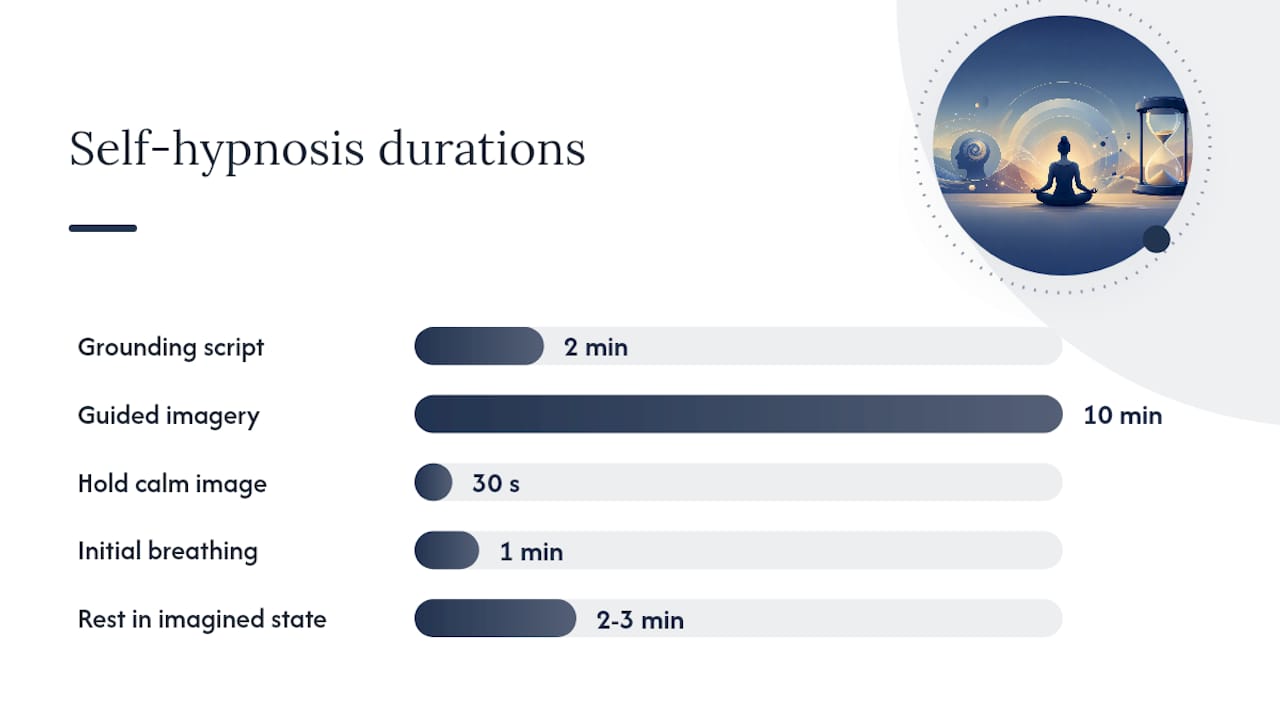
Here's a two-minute grounding script you can use right now, sitting or lying down somewhere quiet:
- Close your eyes and take three slow breaths, letting each exhale last longer than the inhale.
- Silently count from ten down to one, telling yourself with each number that your body is getting heavier and more relaxed.
- Picture a place where you've genuinely felt calm before, real or imagined, and hold that image for thirty seconds.
- Tell yourself silently: "My body knows how to rest. I am safe right now."
- Count from one back up to five, opening your eyes on five, fully alert.
And a ten-minute guided imagery restoration script for when you have more time, ideally somewhere you won't be interrupted:
- Settle into a comfortable position and close your eyes. Breathe slowly for one full minute, letting your shoulders drop with each exhale.
- Imagine walking into a space built entirely for rest, a cabin, a quiet beach, a garden, whatever your mind offers first. Notice the light, the temperature, the sounds.
- In this space, picture a version of yourself who is already rested. Notice how they stand, how they breathe, what their face looks like without tension.
- Imagine stepping into that version of yourself, feeling the tension in your shoulders and jaw dissolve as you do.
- Spend two or three minutes simply resting in that imagined state, letting your real body settle further with each breath.
- When you're ready, count yourself up from one to five, telling yourself you're bringing that restored feeling back with you.
A few rules for using recorded audio versions of these practices matter more than people expect. Never listen while driving or operating machinery, since hypnotic audio is designed to lower alertness. Use headphones in a quiet room rather than a noisy shared space. Three to four times a week works better than one long session on a Sunday. And if a recording brings up unexpected distress rather than calm, stop and bring it up with a clinician rather than pushing through alone.
Sleep-focused hypnosis recordings and session-style recordings serve different purposes: one is built to help you fall asleep, the other to reinforce daytime coping and boundary work, and it helps to use both rather than treating them as interchangeable. For broader self-care practices to run alongside audio work, this guide on healing mentally and emotionally covers complementary daily habits.
Should You Combine Hypnosis with Workplace or Clinical Changes?
Personal interventions like hypnosis work faster and last longer when they're paired with something changing at the source, meaning your job, your workload, or an underlying clinical issue that hypnosis alone can't touch.
The review evidence on this point is fairly clear: interventions aimed only at the individual tend to produce short-term relief, while combining person-directed work with organizational change produces effects that hold up over time. That tracks with common sense. If your burnout is being driven by a genuinely unsustainable workload or an unreasonable manager, hypnosis can help you regulate your nervous system and change your internal response, but it can't rewrite your job description.
A realistic integrated plan looks something like this: weekly hypnotherapy sessions addressing the nervous-system and subconscious drivers, a direct conversation with your manager or HR about workload and boundaries, a referral to occupational health if your employer has that resource, and a conversation with your primary care doctor or a CBT-trained therapist if depression, anxiety, or another clinical condition is tangled up with the burnout itself. Reviews of general burnout interventions suggest CBT and relaxation-based approaches are effective mainly at improving emotional exhaustion, while depersonalization and lost sense of accomplishment, the two harder dimensions, often need more targeted work. That's where hypnosis, with its direct route to subconscious pattern change, tends to add something CBT alone doesn't reach as easily.
How Hypnotic Transformations Approaches Burnout Recovery
Hypnotic Transformations delivers burnout-focused hypnotherapy through live, one-on-one online sessions conducted over Zoom, led by Kirk Hoffman, a Certified Clinical Hypnotherapist (CCHt), with sessions structured around the same core elements the research points to: guided imagery, nervous-system regulation, and between-session audio practice.
Here's what that looks like in practice:
- Live Zoom sessions, typically running 45 to 60 minutes, scheduled around your own timezone rather than a clinic's office hours.
- Personalized audio recordings provided after sessions for home practice, reinforcing the imagery work between appointments.
- A progress-tracking conversation each session, checking in on sleep, exhaustion, and specific triggers rather than treating burnout as one generic problem.
- Package options for clients who want a structured multi-week protocol rather than booking sessions one at a time, mirroring the six-to-eight-session range the clinical research uses.
One statistic worth remembering here: the 1,850-participant training survey is the largest dataset in this field, and it still measured professional training rather than one-on-one patient treatment, which is exactly the gap individualized sessions like these are built to close.
Kirk Hoffman's clinical focus centers on anxiety and fear-based patterns, which overlap heavily with burnout for many clients, since chronic work stress and anxiety often share the same nervous-system pathway. For clients whose burnout is tangled up with anxiety symptoms specifically, the online hypnotherapy for anxiety service page details that particular approach. The full range of session structures and current availability is listed on the services page. A free consultation is the standard first step before committing to any package.
A clinician's note on what actually works
I've watched enough burnout cases up close to know the fear underneath most of them isn't laziness or lack of discipline. It's the fear that slowing down means falling behind permanently, that if you stop pushing even for a week, everything collapses. That fear runs on the same fight-or-flight circuitry as any phobia, and it responds to the same kind of intervention: you have to reach the subconscious rule directly, because arguing with it consciously rarely works. Hypnosis isn't a shortcut around the exhaustion. It's a way to access the part of your mind that's been running the overwork program on autopilot and give it a different instruction, which takes repetition over several weeks, not one dramatic session. I tell every client the same thing: this works alongside whatever else you're doing for your health, not instead of it.
Ready to Start With a Consultation?
Booking a consultation with Hypnotic Transformations starts with a free call where Kirk Hoffman, CCHt, reviews your specific burnout pattern, sleep issues, and work triggers before recommending a session structure, rather than selling you a package on the spot.
Most clients dealing with burnout choose a multi-week option, typically several sessions across a few weeks, since that's the range the clinical research on guided imagery hypnotherapy used to produce measurable change in exhaustion and self-compassion scores. Single sessions are available for clients who want to try the approach first or need help getting through a specific stressful stretch. Every package includes personalized audio recordings for practice between appointments, so the work continues outside the session itself.
Before booking anywhere, confirm the credentials and watch for the red flags covered earlier: no guaranteed cures, no pressure to abandon medical care, no pushy upsells before a single consultation. Kirk Hoffman holds the CCHt credential and works specifically with anxiety and stress-related presentations, which is the clinical territory burnout lives in. If you're ready to talk through your specific situation, the appointments page has current availability, and the full services overview breaks down session options and pricing.
Frequently Asked Questions
Can hypnosis actually help with burnout, or is it just relaxation?
It does more than relax you. Studies measuring EEG and MBI scores found progressive changes in emotional exhaustion and self-compassion across weeks of guided imagery hypnotherapy, not just a temporary calm during the session itself.
How is hypnotherapy for burnout different from a guided meditation for burnout?
Guided meditation typically keeps you in a mildly relaxed, aware state and focuses on present-moment attention. Hypnosis uses a deeper trance state to deliver targeted suggestions aimed at specific subconscious patterns, like people-pleasing or an inability to rest, which meditation doesn't directly target.
How does hypnosis compare to CBT or mindfulness for burnout?
CBT and mindfulness-based approaches tend to improve emotional exhaustion reliably but often leave depersonalization and lost sense of accomplishment less addressed. Hypnosis works more directly on the subconscious rules driving overwork, which makes it a useful addition rather than a straight replacement.
Is one hypnosis session enough to fix burnout?
No. A single session can lower acute stress for a day or two, but the studies showing real change in exhaustion and self-compassion used six to eight weekly sessions, not one.
Are there risks to trying hypnosis for burnout?
Hypnosis is low-risk for most adults, but it isn't appropriate as a first response to suicidal thoughts, active psychosis, severe dissociation, or unprocessed trauma. Those situations need medical or psychiatric care first.
Sources
These sources were selected because they include peer-reviewed data, meaningful sample sizes for this niche field, or direct clinical relevance to burnout treatment planning.
- Effects of a training program in medical hypnosis on burnout in anesthesiologists and other healthcare providers: A survey study - PubMed
- Alleviating Job-Related Burnout in Medical Professionals through Guided Imagery Hypnotherapy - PMC
- Is Hypnosis an Effective Intervention for Burnout? – The International Society for Hypnosis
- Hypnosis for Burnout Recovery - International Hypnosis Association