
Attachment anxiety hypnosis can genuinely calm the fear of abandonment and the constant need for reassurance that anxious attachment creates, but only under specific conditions. It requires a trained clinical hypnotherapist, a session structured around felt safety rather than quick fixes, and a client willing to sit with discomfort long enough for the nervous system to recalibrate. The goal is not relaxation, but rewiring how your body responds to relational fear.
TL;DR:
- Attachment style influences the hypnotic experience, with anxious individuals experiencing more internal chatter and restlessness but still being capable of deep responses.
- Effective hypnotherapy requires slower pacing, regular safety checks, and longer grounding to accommodate the heightened inner dialogue of anxious or avoidant clients.
- Techniques such as safe-place imagery, Good Enough Parent Protocol, and Internal Secure Base imagery are central to rewiring relational fears during sessions.
- Results involve reduced hypervigilance and calmer internal dialogue, with changes often appearing days or weeks after sessions, not immediately.
- A qualified clinician should conduct multiple sessions focused on pacing and safety, especially for clients with strong attachment wounds or complex trauma histories.
Table of Contents
- How Hypnotherapy Addresses the Root of Attachment Anxiety
- What Does Research Say About Attachment and Hypnosis?
- What Happens During a Hypnotherapy Session for Attachment Anxiety?
- Techniques and Scripts Used for Attachment-Focused Hypnotherapy
- Who Is a Good Candidate for This Kind of Hypnotherapy?
- An Editorial Take on Attachment-Focused Hypnotherapy
- How to Get Started with Attachment-Focused Hypnotherapy
- Ready to Work Directly on Your Attachment Anxiety?
- Sources
How Hypnotherapy Addresses the Root of Attachment Anxiety
Anxious attachment isn't a personality flaw. It's a nervous system that learned, early and repeatedly, that closeness is unreliable. When a partner takes two hours to text back, your brain doesn't process that as mildly annoying. It processes it as danger, the same fight-or-flight signal that would fire if you smelled smoke in your house. That's the mechanism hypnotherapy for attachment issues is built to interrupt.
Clinical hypnosis works by bypassing the analytical, defensive part of the mind and speaking directly to the subconscious patterns that generate the panic in the first place. A skilled hypnotherapist doesn't argue with your fear. Instead, the therapist uses what's called a utilization approach: modeling calm, attentive, responsive presence throughout the session so your nervous system experiences something it may never have consistently experienced before. Attunement, without the unpredictability.
Three techniques do most of the work in this kind of session:
- Safe-place imagery anchors the body in a state of physical safety before any deeper relational material gets touched.
- Good Enough Parent Protocol guides the client through imagined interactions with a caregiver who responds with the consistency the client didn't get growing up, which helps update old implicit memory.
- Internal secure base imagery rehearses what it feels like to trust that support will still be there tomorrow, not just in the room right now.
There's a plausible biological story behind why this works. One integrative framework connecting hypnosis, attachment, and oxytocin proposes that hypnotic suggestions simulating secure and attuned caregiving can function as a corrective relational experience, with oxytocin-related pathways as a likely biological link. That's still a theoretical model, not a proven mechanism, but it lines up with what clinicians observe: clients who go through this work report fewer spirals into worst-case thinking after a partner goes quiet for a day.
Pro Tip: If you leave a session feeling calmer but skeptical that "it worked," that's normal. Nervous system change shows up in your reactions over the following days and weeks, not in how relaxed you felt in the chair.
The realistic outcome goals here are specific: less hypervigilance when a partner is unreachable, quieter internal dialogue during moments of relational uncertainty, and a stronger ability to sink into calming imagery instead of staying on guard the whole session.
What Does Research Say About Attachment and Hypnosis?
People with anxious or avoidant attachment styles do not experience hypnosis the same way securely attached people do, and that difference matters for how a clinician should run the session.
A 2024 study in Frontiers in Psychology measured hypnotic response using the ECR-R attachment scale alongside the Phenomenology of Consciousness Inventory. Anxiously attached participants showed significantly more internal dialogue during hypnosis, meaning more of that inner voice narrating, questioning, or second-guessing the process instead of letting go into it. Avoidantly attached participants showed lower absorption, the depth to which someone sinks into the suggested imagery. Both groups also reported more restlessness than securely attached participants.
Here's the detail that changes how a first-time client should think about all this:
Insecure attachment predicted the subjective texture of the hypnotic experience, including more internal chatter and restlessness, but did not consistently predict objective hypnotizability as measured by standardized scales like the Harvard Group Scale.
In plain terms: your attachment style shapes what hypnosis feels like, not whether you're capable of responding to it. If you've ever worried you're "too anxious to be hypnotized," the research says otherwise. You may just experience more inner commentary along the way, and a competent hypnotherapist expects that.
That expectation shapes clinical behavior in a few concrete ways:
- Clinicians should normalize restlessness rather than treat it as resistance or failure.
- Pacing slows down, with more grounding checkpoints instead of one long, uninterrupted deepening.
- Rapport-building takes longer before any attachment-specific imagery gets introduced.
- Sessions may need to be shorter, more frequent, and built around repeated safety checks rather than a single dramatic breakthrough attempt.
This lines up with broader findings on what actually changes through hypnosis and relationship-focused work, where the emotional shift tends to build across sessions rather than arrive all at once.
What Happens During a Hypnotherapy Session for Attachment Anxiety?
A session built around attachment anxiety follows a predictable shape, even though the pacing bends to fit each client.
- Intake and rapport building. The therapist asks about your relationship history, specific triggers (a delayed text, a canceled plan, a partner pulling back emotionally), and what "safety" has and hasn't felt like in your past relationships.
- Induction and grounding. A slow, unhurried induction, often longer for anxious clients than the standard script, since anxious minds need more time to trust the process before letting go.
- Core imagery. This is where safe-place work or Good Enough Parent imagery gets introduced, always after grounding is solid.
- Installation. The therapist links the new felt sense of security to a specific cue or memory the client can return to outside the session.
- Debrief and homework. You talk through what came up, and you usually leave with a short daily practice, often five to ten minutes, to reinforce the new response.
Expect some inner chatter. Expect restlessness in the first few minutes, especially in your first session or two. Expect your mind to wander toward doubt ("is this actually doing anything?") before it settles. All of that is documented, not a sign you're doing it wrong.
Pro Tip: Tell your therapist upfront if you tend to overthink during quiet moments. A good clinician will adjust pacing and use more verbal guidance instead of long silences, which reduces the internal dialogue that pulls anxious clients out of the process.
Most clients notice a session runs around an hour to an hour and a half. Weekly sessions extended over several weeks tend to produce more consistent change than sporadic monthly visits, since the nervous system responds to repetition.
Techniques and Scripts Used for Attachment-Focused Hypnotherapy
These protocols illustrate what clinical hypnotherapy for attachment issues actually looks like in practice. They are not scripts to run on yourself. Attachment wounds sit close to core survival fears, and reopening them without a trained clinician present to manage the pacing can leave you more dysregulated, not less.
The Good Enough Parent Protocol walks a client through an imagined interaction with a caregiver figure who responds the way the client needed as a child: present, consistent, unbothered by the client's needs. The goal isn't to rewrite history. It's to give the implicit memory system a new reference point for what "safe adult presence" actually feels like, since practitioner literature on clinical hypnosis and attachment describes this kind of modeled attentiveness as central to the therapeutic mechanism.
Safe-place imagery starts every session that touches attachment material. A typical fragment sounds something like: "Notice a place, real or imagined, where nothing is required of you. Notice what you can see there. Notice that you don't have to perform, explain, or earn your right to be there." The deepening happens slowly, with frequent checks, because rushing this step is exactly what triggers the restlessness the Frontiers study documented.
The Internal Secure Base Protocol takes the felt safety built in the safe place and rehearses it against a real trigger: a partner not responding for a few hours, a plan changing last minute. The client imagines the trigger occurring while staying anchored in the secure feeling, which builds a new automatic association.
- Grounding cues (breath counts, a hand on the chest) get repeated throughout to keep restlessness from derailing absorption.
- Pacing stays slower than standard anxiety protocols, since attachment material tends to surface more inner dialogue.
- Sessions often close with a brief return to safe-place imagery, so clients leave regulated rather than raw.
Pro Tip: If a hypnosis app or recording promises to "fix your attachment style" in one 20 minute track, be skeptical. The research behind this work points to a slower, clinician-guided process, not a shortcut.
Who Is a Good Candidate for This Kind of Hypnotherapy?
Good candidates are adults who recognize a pattern (panic when a partner is unreachable, difficulty trusting reassurance, a racing mind during conflict) and want to change the automatic response, not just talk about it. Readiness usually shows up as willingness to sit with discomfort for a few sessions before expecting relief.
Contraindications matter here, and a responsible clinician screens for them before starting:
- Unmanaged psychosis or active dissociative episodes
- Active suicidal ideation without a current safety plan or concurrent care
- Uncontrolled substance use that affects the ability to stay present
- Severe trauma history without stabilization already in place
Before booking, ask a potential therapist how they screen for these issues, what their emergency plan looks like if something comes up mid-session, and how they document informed consent. A qualified clinician will answer these questions directly, not vaguely. You can read more about the scope and limits of this work in this clinical definition of hypnotherapy.
An Editorial Take on Attachment-Focused Hypnotherapy
Most articles on this topic oversell hypnosis as a single-session cure and undersell what the research actually shows: that anxious attachment changes the texture of the hypnotic experience, not whether it works. That distinction gets lost constantly. Clients read that hypnosis "can rewire the subconscious" and expect a breakthrough in one sitting, then feel discouraged when session one is mostly grounding and rapport-building.
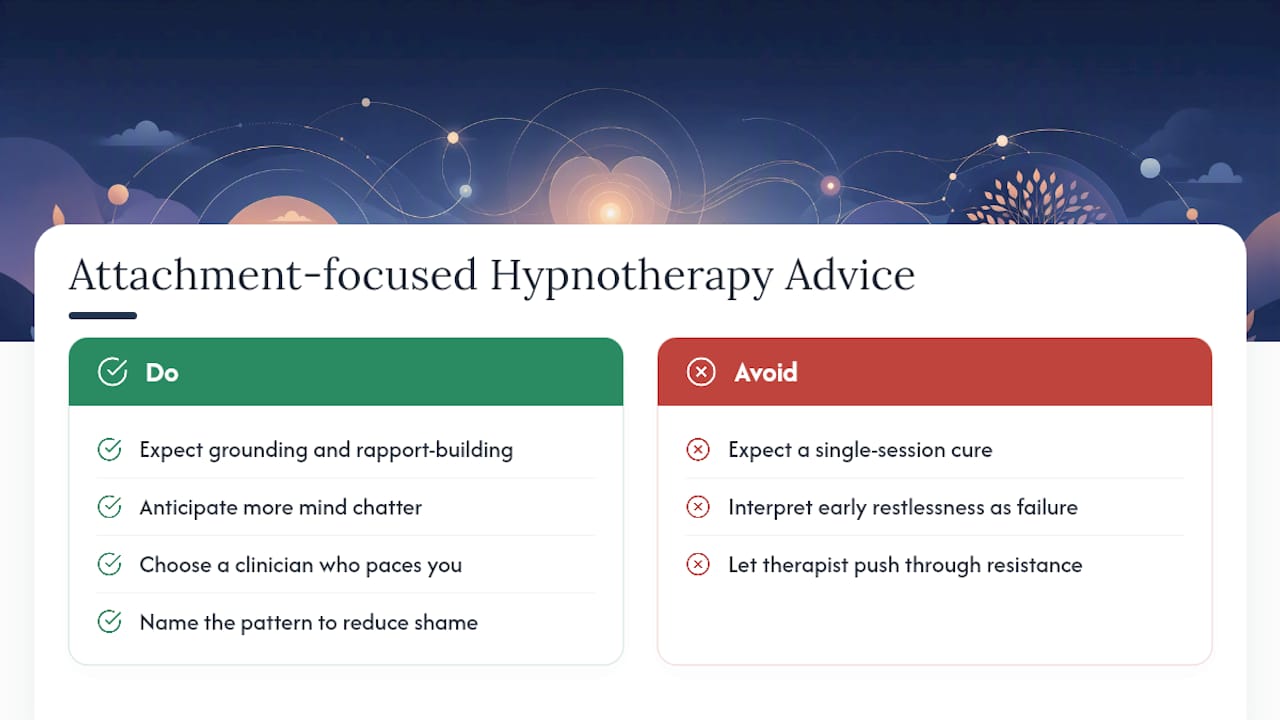
The conventional advice skips the restlessness entirely. Nobody warns anxious clients that their minds will chatter more, wander more, and resist settling faster than a securely attached client's would. That's not a flaw in the process. It's the exact pattern the nervous system is trying to protect against, and naming it upfront removes the shame that would otherwise make someone quit after one session.
What should come first, before any script or protocol, is finding a clinician who expects this pattern and paces around it instead of pushing through it. The technique matters less than the therapist's patience with your particular nervous system.
— Kirk
How to Get Started with Attachment-Focused Hypnotherapy
Before booking, check that a clinician holds real credentials (Certified Clinical Hypnotherapist, not a weekend certificate), has specific experience with attachment or relational anxiety, and runs sessions on stable, private video software if working online.
Ask directly: How do you pace sessions for anxious clients? What happens if I get overwhelmed mid-session? How many sessions before I should expect a noticeable shift? Expect a short intake form covering relationship history and current triggers before your first appointment.
Kirk Hoffman, a Certified Clinical Hypnotherapist, offers online sessions built specifically around anxiety and attachment work, with a free initial consultation to check fit before you commit to a package.
Ready to Work Directly on Your Attachment Anxiety?
If you've read this far, you already know self-help scripts only go so far with attachment wounds this deep. What you actually need is a clinician who paces sessions around your specific nervous system response, not a generic relaxation track. Hypnotictransformations offers exactly that: one-on-one online sessions with Kirk Hoffman, a Certified Clinical Hypnotherapist, built around the exact grounding and pacing adjustments anxious attachment requires.
Sessions run over Zoom, so you can do this work from home without a waiting room or a drive across town. Kirk starts every new client with a consultation to map out your specific triggers, whether that's fear of abandonment, panic during silence from a partner, or racing thoughts during conflict, before designing your session structure. If this article described your experience more accurately than anything else you've read, book a consultation through the appointments page and find out what a session paced specifically for your nervous system actually feels like.
Sources
- Intimate relationships and hypnosis: insecure adult attachment affects emotions and absorption during hypnosis (Frontiers in Psychology, 2024)
- Hypnosis, attachment, and oxytocin: an integrative perspective (2014)
- Clinical hypnosis and attachment-related approaches (PubMed entry)